The Industrial Revolution: Transforming America Through Innovation and Urbanization
The Industrial Revolution marked a significant turning point in American history, as inventions and technological advancements led to a surge in factory jobs and urban migration. Factories, although poorly lit and lacking fresh air, utilized interchangeable parts to boost manufacturing efficiency. Key innovations included Samuel Morse's telegraph for communication, Robert Fulton's steamboat for transportation, and Eli Whitney's cotton gin, which revolutionized cotton processing. The completion of the Transcontinental Railroad on May 10, 1869, connected the nation and facilitated travel and trade.


The Industrial Revolution: Transforming America Through Innovation and Urbanization
E N D
Presentation Transcript
Industrial Revolution As more inventions and technology increased, many Americans began working in factories and moving to large cities.
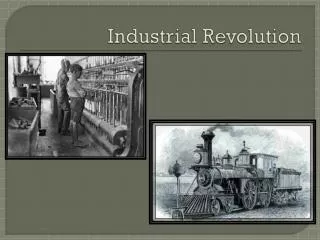
Factories Factories were poorly lighted with little fresh air. Factories used interchangeable parts which made manufacturing more efficient.
Telegraph Samuel Morse invented a machine that sent electrical signals over a wire.
Steamboat In 1807 Robert Fulton used a steam engine to power a boat. Steamboats were used to move people and cargo on the rivers
Cotton Gin In 1793, Eli Whitney invented a simple machine that speeded the processing of cotton. A worker could process 50 times more cotton fiber with the gin than by hand.
Transcontinental Railroad May 10, 1869 the Central Pacific and Union Pacific Railroads met which made travel all across the United States possible.