The Respiratory System
Explore the functions and workings of the respiratory system, from providing oxygen to removing carbon dioxide. Learn about the structure, processes, strengths, and weaknesses of this vital system.

The Respiratory System
E N D
Presentation Transcript
The Respiratory System By SimranSidhu and AryaSureshbabu
Function What exactly does the system do?
General Functions • Provide body with enough oxygen to carry out functions • Rid body of excess carbon dioxide Oxygen Carbon Dioxide
The Process How does the system work?
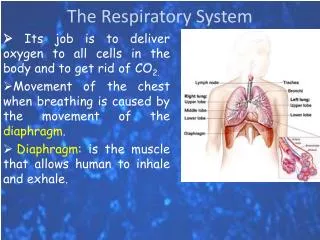
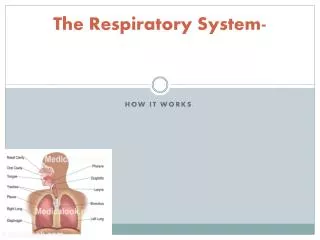
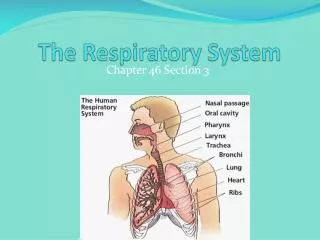
Overview • Diagram shows entire system • Air goes from mouth to lungs, then back out
Diaphragm • Underneath the lungs • Muscle that controls entire system • Contracts to allow lungs to expand • Expands so lungs can contract
Nose, Mouth, and Trachea • Air enters through nose or mouth • Warm, moisturize and filter the air • Cilia picks up particles • Nasal passageway longer • Both from mouth and nose go to trachea (windpipe) • Eventually leads to lungs
Lungs • Travels through lungs in bronchi • Bronchi branch out into smaller passageways (bronchioles) • Alveoli are found at the end of bronchioles • Allow oxygen to pass into bloodstream and carbon dioxide out to lungs
Strengths Reasons why the respiratory system is reliable
Simplicity • Relatively few organs • Organs don’t have too many complex parts • Example: Brain has many different lobes, functions, and sections, so damage to one part can affect body as a whole. • Example (cont’d):Lungs, on the other hand, serve only one function, so not as many ways in which things can go wrong
Compact Area • Only in chest cavity • Unlike other systems, does not have extensions to fingers, toes, etc. • Cannot be physically damaged from outside unless injured directly in chest
Weaknesses Problems that may occur
Exposure to Foreign Particles • Receives air directly into system • Particles in the air: pathogens, chemicals, poisonous gasses, carcinogens in tobacco smoke • Cilia cannot capture all the particles, so some can reach lungs and cause serious problems
Lung Cancer and Pneumonia • Carcinogens in tobacco smoke cause cancerous tumors to form on lungs • Cancer can spread to further body parts and could cause death • Pneumonia caused when viruses or bacteria are inhaled • Shortness of breath, coughing up mucus, chest pain, nausea, etc. are symptoms • Best cured by bed rest
Asthma • Chronic disease that constricts airways • Common asthma triggers: polluted air, tobacco smoke, factory fumes, cleaning solvents, pollens, and chemicals • When substance enters body, airways become irritated and constrict/fill with mucus to keep substance out • Also prevents air from getting through • Asthma patients must take emergency relief • Consistently take preventative medicine
What You Can Do • Don’t smoke. Tobacco smoke is one of the leading causes of lung cancer. • Be conscious of the air around you. If you feel that it’s polluted heavily, try to get some fresh air. • If you have asthma, always have an emergency inhalant on hand. • Exercise to improve lung capacity.