Sample Size Determination and Power Analysis in Biostatistics
This lecture focuses on the determination of sample sizes for biostatistical studies, highlighting key concepts such as the significance of the α ratio, total sample size requirements, and desired statistical power. Examples demonstrate how to calculate total sample sizes for various conditions, including interactions between strata and treatments. The discussion includes methods to insert proportions and probabilities within each cell of analysis, aiming to detect significant interactions in research settings. This foundational knowledge is critical for conducting robust statistical analyses in biomedicine.

Sample Size Determination and Power Analysis in Biostatistics
E N D
Presentation Transcript
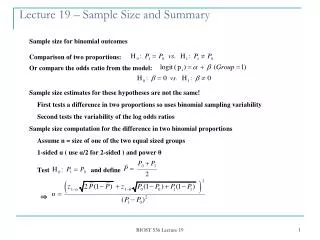
Lecture 19 – Sample Size and Summary BIOST 536 Lecture 19
Insert P0 < P1 ; α; ratio of sample sizes;desired power Total sample size Total sample size =268 so 134 per group BIOST 536 Lecture 19
Insert proportions in each cellInsert probability P0 in each stratum and the expected OR;desired power Total sample size Total sample size = 1656 to detect a significant interaction between stratum and treatment (exposure) BIOST 536 Lecture 19
Quick Review BIOST 536 Lecture 19