Download
1 / 9
110 likes | 272 Vues
This outline provides a comprehensive guide for researchers navigating the research process. It covers critical steps including how to generate research ideas, review literature, formulate a hypothesis, choose appropriate methods, gather and analyze data, and interpret results. Researchers are encouraged to start with interesting topics, build on existing literature, clearly define variables, and maintain organization throughout the research process. The guide emphasizes flexibility in following the steps and stresses the importance of context in interpreting findings.

E N D
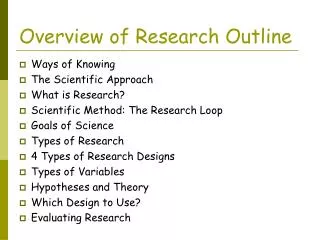
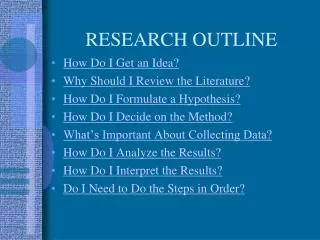
RESEARCH OUTLINE • How Do I Get an Idea? • Why Should I Review the Literature? • How Do I Formulate a Hypothesis? • How Do I Decide on the Method? • What’s Important About Collecting Data? • How Do I Analyze the Results? • How Do I Interpret the Results? • Do I Need to Do the Steps in Order?
How Do I Get an Idea? • Start with a topic you find interesting. • An idea that springs from the literature is more likely to add to the literature. • Don’t try to do everything with one study.
Why Should I Review the Literature? • Relevant theories and constructs • Research methods and instruments • Previous findings • Gaps or inconsistencies in the literature
How Do I Formulate a Hypothesis? • Variables must have operational definitions. • Decide on a population of interest. • Must be scientific: falsifiable, precise, rational, parsimonious. • It’s okay to be wrong.
How Do I Decide on the Method? • Choose the method based on the hypothesis. • Select a sample. • Develop a research protocol. • Locate resources. • Obtain IRB approval.
What’s Important About Collecting Data? • Be organized and professional. • Follow the research protocol. • Do a pilot study if possible.
How Do I Analyze the Results? • Descriptive statistics - organize and summarize scores • Inferential statistics - generalize from sample to population
How Do I Interpret the Results? • Evaluate the hypothesis. • Be cautious and conservative. • Context of justification vs. context of discovery
Do I Need to Do the Steps in Order? • “Begin at the beginning, and go on till you come to the end: then stop.” • Don’t get ahead of yourself. • Go back and forth as needed.