

SlideServe
Menu
Préférences
© SlideServe · v2026

Metals & Reactivity

bijan avatar
6 diapositives · 416 Views · Jul 22, 2014

Metals & Reactivity. http:// www.amazingrust.com/Experiments/how_to/Thermite.html. Today’s Lesson. Metals & Reactivity Things That Go Boom Reactivity Series. Metals & Reactivity. Group 1 metals are reactive. Group 2 metals are less reactive.
Metals & Reactivity - slide 1
01 / 6Metals & Reactivity
1 / 17

Télécharger la présentation

Metals & Reactivity
Une image / un lien ci-dessous est fourni (tel quel) pour télécharger la présentation

Politique de téléchargement : le contenu du site vous est fourni TEL QUEL pour votre information et votre usage personnel ; il ne peut être vendu, concédé sous licence ni partagé sur d’autres sites sans l’accord de son auteur.Le contenu vous est fourni TEL QUEL, pour votre information et votre usage personnel uniquement. Téléchargez la présentation en cliquant sur ce lien. Lors du téléchargement, si vous ne parvenez pas à télécharger une présentation, l’éditeur a peut-être supprimé le fichier de son serveur.Pendant le téléchargement, si vous ne parvenez pas à obtenir une présentation, le fichier a peut-être été supprimé par l’éditeur.

F I N

Plus de contenu associé

Transcription de la présentation
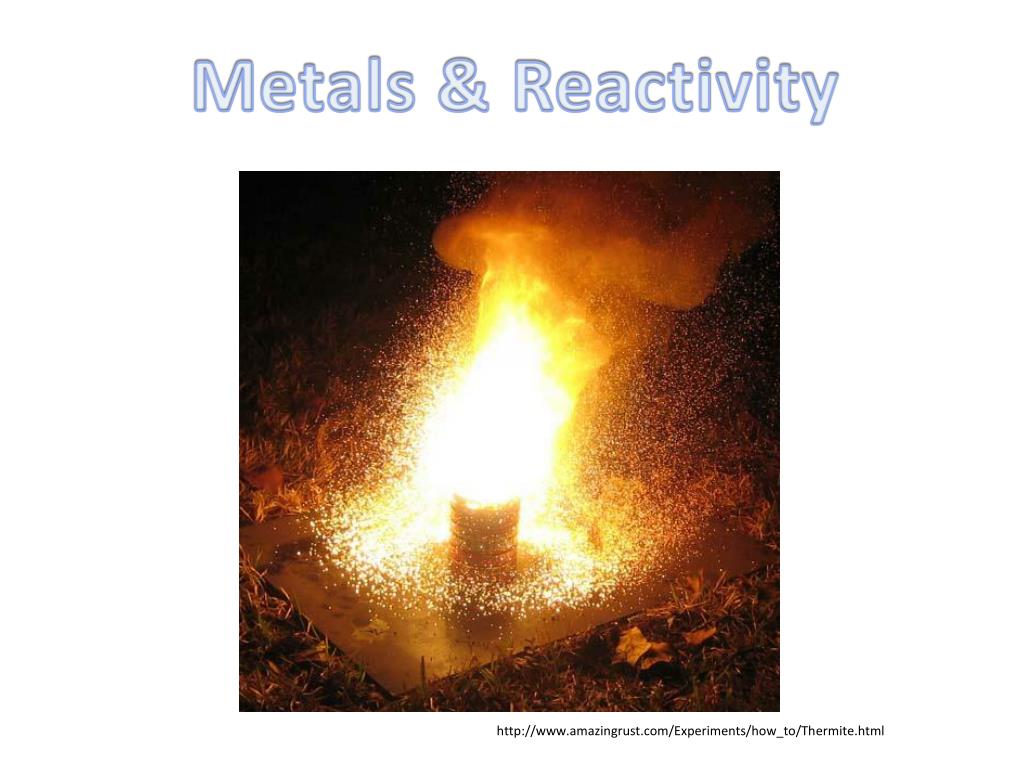
  1. Metals & Reactivity http://www.amazingrust.com/Experiments/how_to/Thermite.html

  2. Today’s Lesson • Metals & Reactivity • Things That Go Boom • Reactivity Series

  3. Metals & Reactivity • Group 1 metals are reactive. • Group 2 metals are less reactive. • We can also work this out by testing them against oxygen, water and hydrochloric acid • Simple Rule: The more reactive the metal, the faster and more violent it’s reaction will be. • For oxygen, metals tend (but not always) to become more reactive as you go to the left on the periodic table

  4. Continued • For water, the metals tend to be more reactive as you go to the left. • For hydrochloric acids, the metals tend to become more reactive as you go to the left. • Does anyone notice a trend or pattern forming here???

  5. Reactivity Series • Scientists are lazy and don’t like to remember things, so we put things in tables!! • Our table is called the reactivity series table. • When a metal is heated with an oxide (like Iron II Oxide) of a less reactive metal, it takes the oxygen from it. The reaction is exothermic. • Exothermic = produces heat in a reaction (produces energy) • Endothermic = loses heat in a reaction (requires energy)

  6. Continued • A metal will always displace (replace) a less reactive metal from solutions of its compounds. This is called a displacement reaction • I’m hoping that we might be able to make Silver Crystals next lesson. They won’t be ready the following lesson • Read Page 66/67 and answer Q 1-5 • Read Page 68/69 and answer Q 1-7. (Time Dependant)