Enhancing Astronomy with Workflows: Survey Pipelines and the Virtual Observatory
This paper discusses the integration of workflows in astronomy, focusing on survey pipelines and the Virtual Observatory (VO). It highlights standards for data formats like VOTable and query languages such as SIAP and ADQL. The study examines pipelines for photometry and coordinate systems, using examples from the Solar System, including planets and asteroids. The methodology emphasizes the importance of follow-up observations for orbit determination and introduces dynamic event-driven routing for data flows. The goal is to enhance reusability and integration, making it feasible for graduate students to create effective workflows rapidly.

Enhancing Astronomy with Workflows: Survey Pipelines and the Virtual Observatory
E N D
Presentation Transcript
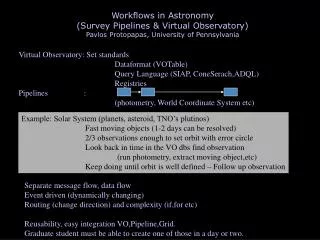
Workflows in Astronomy(Survey Pipelines & Virtual Observatory)Pavlos Protopapas, University of Pennsylvania Virtual Observatory: Set standards Dataformat (VOTable) Query Language (SIAP, ConeSerach,ADQL) Registries Pipelines : (photometry, World Coordinate System etc) Example: Solar System (planets, asteroid, TNO’s plutinos) Fast moving objects (1-2 days can be resolved) 2/3 observations enough to set orbit with error circle Look back in time in the VO dbs find observation (run photometry, extract moving object,etc) Keep doing until orbit is well defined – Follow up observation Separate message flow, data flow Event driven (dynamically changing) Routing (change direction) and complexity (if,for etc) Reusability, easy integration VO,Pipeline,Grid. Graduate student must be able to create one of those in a day or two.