Analysis of Projectile Motion
60 likes | 175 Vues
This analysis explores the characteristics of projectile motion through the examination of Horizontal and Vertical Distance vs. Time graphs. The constant slope of the horizontal graph indicates constant horizontal velocity and no acceleration in that direction. Conversely, the vertical graph's increasing slope reveals that the object accelerates downward due to gravity, following a parabolic trajectory. Key conclusions include that horizontal speed remains constant while vertical acceleration is influenced by gravity, and both motions operate independently.


Analysis of Projectile Motion
E N D
Presentation Transcript
What type of motion is represented by this Horizontal Distance Vs. Time graph? D t
Since the slope of the line is constant, the horizontal velocity is constant. • There is no acceleration in the horizontal direction.
What type of motion is represented by this Vertical Distance Vs. Time graph? D t
Since the slope increases (the graph is curved), the vertical velocity increases as well. That is, the object accelerates in the vertical direction. The rate of acceleration is that of gravity.
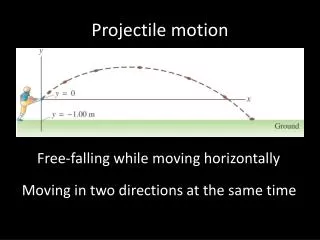
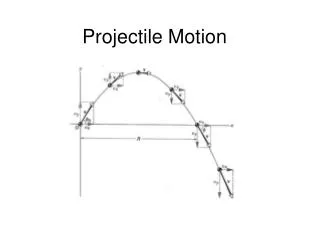
Conclusions: • The horizontal speed is constant; so Dh = vh t. • Vertically the object accelerates due to gravity; so Dv = ½ at^2. • The path of a projectile is parabolic. • The vertical and horizontal motions are independent of one another. • A horizontally launched object, and an object dropped from the same height, will hit the ground below at the same time.