
SlideServe
Menu
Préférences
© SlideServe · v2026

Section 13 - 2

birch avatar
22 diapositives · 691 Views · Oct 09, 2014

Section 13 - 2. Tides EQ: What causes tides?. Tides. What causes tides? How can tides be used to generate electricity? Describe the positions of the sun and the moon, in relation to Earth when spring tides occur. Tides.
Section 13 - 2 - slide 1
01 / 22Section 13 - 2
1 / 17

Télécharger la présentation

Section 13 - 2
Une image / un lien ci-dessous est fourni (tel quel) pour télécharger la présentation

Politique de téléchargement : le contenu du site vous est fourni TEL QUEL pour votre information et votre usage personnel ; il ne peut être vendu, concédé sous licence ni partagé sur d’autres sites sans l’accord de son auteur.Le contenu vous est fourni TEL QUEL, pour votre information et votre usage personnel uniquement. Téléchargez la présentation en cliquant sur ce lien. Lors du téléchargement, si vous ne parvenez pas à télécharger une présentation, l’éditeur a peut-être supprimé le fichier de son serveur.Pendant le téléchargement, si vous ne parvenez pas à obtenir une présentation, le fichier a peut-être été supprimé par l’éditeur.

F I N

Plus de contenu associé

Transcription de la présentation
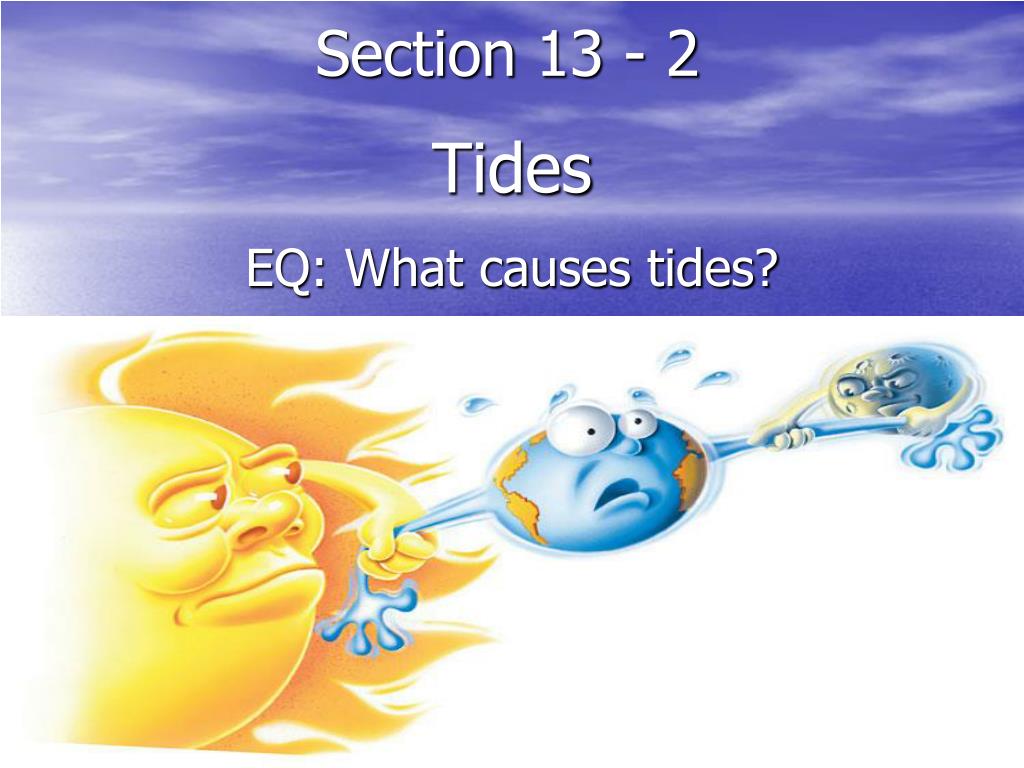
  1. Section 13 - 2 Tides EQ: What causes tides?

  2. Tides What causes tides? How can tides be used to generate electricity? Describe the positions of the sun and the moon, in relation to Earth when spring tides occur.

  3. Tides • A tide is the rise and fall of the ocean’s surface caused mostly by the gravitational pull of the moon.

  4. Tides • At low tide, the ocean water has fallen as low as it can go on a shore. • At high tide, the ocean water has risen as high as it will go on a shore.

  5. Tides • A tide is the rise and fall of the ocean’s surface caused mostly by the gravitational pull of the moon.

  6. Tides

  7. Tides • Earth’s rotation on its axis affects which tides will occur at a certain place on Earth. • High tides occur about every 12 hrs. • Low tides occur about every 12 hours. • The time between low tide and high tide is about 6 hrs.

  8. What causes tides? • Tides are caused by the interaction of Earth, the moon, and the sun. • The moon pulls on the water on the side closest to it more strongly than it pulls on the center of the Earth.

  9. What causes tides? • The moon’s pull creates a bulge of water, called a tidal bulge, on the side of Earth facing the moon. • The water opposite the moon is pulled toward the moon less strongly than the water facing the moon. • This water is “left behind,” forming a second bulge.

  10. The Daily Tide Cycle • As Earth turns completely around once each day, people on or near the shore observe the rise and fall of the tides as they reach the area of each tidal bulge. • The high tides occur about 12 hrs. and 25 mins. Apart in each location.

  11. Tides occur at different locations on Earth because the Earth rotates more quickly than the moon revolves around the Earth.

  12. Effects of Daily Tides

  13. Photos Showing Progress of high tide coming in http://www.watchknowlearn.org/Video.aspx?VideoID=23446&CategoryID=6422

  14. The Monthly Tide Cycle • Changes in the positions of Earth, the moon, and the sun affect the height of the tides during a month.

  15. The Monthly Tide Cycle • Twice a month, at the new moon and the full moon, the sun and moon are in a straight line. • Their combined gravitational pull produces the greatest range between high and low tide, called a spring tide.

  16. The Monthly Tide Cycle • In between spring tides, at the first and third quarters of the month, the sun and moon pull at right angles to each other, producing a neap tide. • A neap tide is a tide with the least difference between low and high tide.

  17. The Monthly Tide Cycle

  18. The Monthly Tide Cycle Spring Tide Neap Tide

  19. The Monthly Tide Cycle • The movement of large amounts of water between high and low tide are a source of potential energy—energy that is stored and waiting to be used. • Spring tide • Full moon-highest tide • New moon • Neap Tide- half moon

  20. Spring Tides and Neap Tides

  21. Spring Tides and Neap Tides

  22. Spring Tides and Neap Tides