This comprehensive guide covers projective 2D geometry, including points, lines, conics, transformations, invariants, and projective linear group concepts. It discusses the homogeneous representation of points and lines, operations on projective spaces, and key theorems in projective geometry. You will learn about projective transformations, degenerate conics, dual conics, and how projectivities relate to collineations and homographies. Dive into the realm of projective geometry with detailed explanations and examples.
01 / 96Projective 2D Geometry: A Comprehensive Guide
1 / 17
Télécharger la présentation
Projective 2D Geometry: A Comprehensive Guide
Une image / un lien ci-dessous est fourni (tel quel) pour télécharger la présentation
Politique de téléchargement : le contenu du site vous est fourni TEL QUEL pour votre information et votre usage personnel ; il ne peut être vendu, concédé sous licence ni partagé sur d’autres sites sans l’accord de son auteur.Le contenu vous est fourni TEL QUEL, pour votre information et votre usage personnel uniquement.Téléchargez la présentation en cliquant sur ce lien.Lors du téléchargement, si vous ne parvenez pas à télécharger une présentation, l’éditeur a peut-être supprimé le fichier de son serveur.Pendant le téléchargement, si vous ne parvenez pas à obtenir une présentation, le fichier a peut-être été supprimé par l’éditeur.
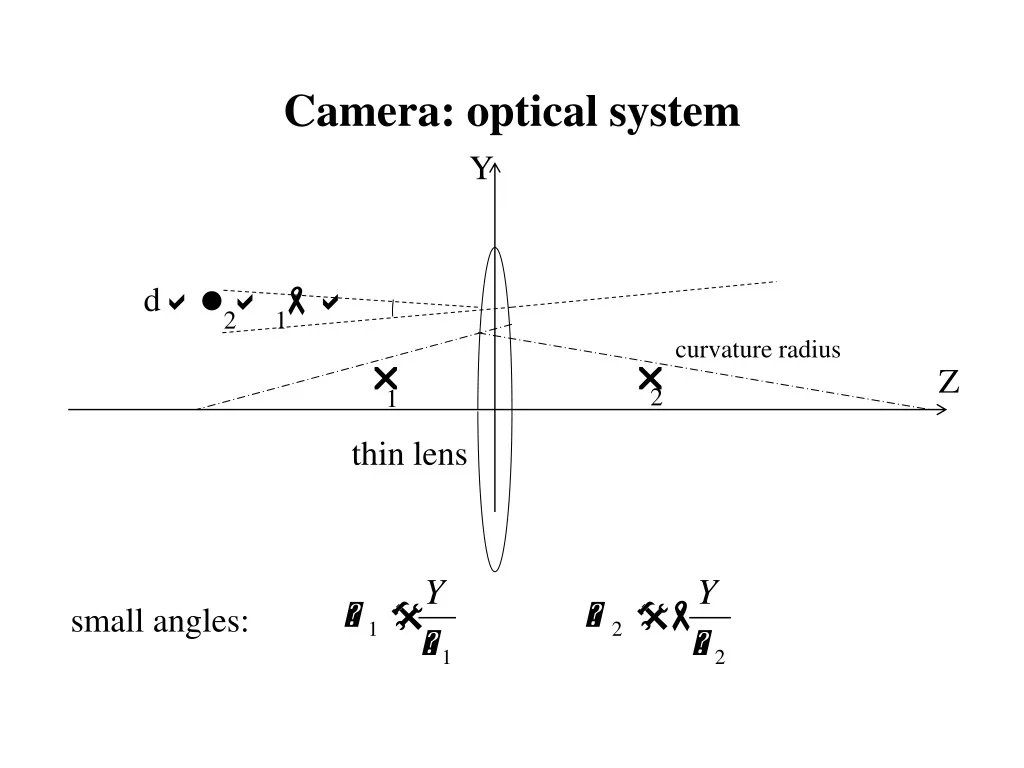
Y incident light beam lens refraction index: n deviated beam Z deviation angle ? Dq =q’’-q
Thin lens rules a) Y=0 Dq = 0 beams through lens center: undeviated b) f Dq = Y independent of y parallel rays converge onto a focal plane Y f Dq
r f Hp: Z >> a the image of a point P belongs to the line (P,O) P image plane O p p = image of P = image plane ∩ line(O,P) interpretation line of p: line(O,p) = locus of the scene points projecting onto image point p
Projective 2D geometry Notes based on di R.Hartley e A.Zisserman “Multiple view geometry”
Projective 2D Geometry • Points, lines & conics • Transformations & invariants • 1D projective geometry and the Cross-ratio
Homogeneous representation of points on if and only if Homogeneous coordinates but only 2DOF Inhomogeneous coordinates Homogeneous coordinates Homogeneous representation of lines equivalence class of vectors, any vector is representative Set of all equivalence classes in R3(0,0,0)T forms P2 The point x lies on the line l if and only if xTl=lTx=0
Line joining two points The line through two points and is Points from lines and vice-versa Intersections of lines The intersection of two lines and is Line joining two points: parametric equation A point on the line through two points x and x’ is y = x + q x’ Example
tangent vector normal direction Example Ideal points Line at infinity Ideal points and the line at infinity Intersections of parallel lines Note that in P2 there is no distinction between ideal points and others
Example • The linear combination z = ax + by of two points x and y is a point zcolinear with them (i.e., on the line through x and y) • The linear combination n = al + bm of two lines l and m is a line nconcurrent with them (i.e., through the point on l and m)
or homogenized or in matrix form with Conics Curve described by 2nd-degree equation in the plane 5DOF:
or stacking constraints yields Five points define a conic For each point the conic passes through
Polarity: cross ratio Cross ratioof 4 colinear points y = x + q x’ (with i=1,..,4) ratio of ratios i i Harmonic 4-tuple of colinear points: such that CR=-1
In general (C full rank): in fact Dual conics A line tangent to the conic C satisfies -1 T Linelis thepolar line of y : y = Cl , but since y Cy = 0 l CCC l = 0 C = C = C -T -1 T -T -1 * Dual conics = line conics = conic envelopes
Note that for degenerate conics Degenerate conics A conic is degenerate if matrix C is not of full rank e.g. two lines (rank 2) e.g. repeated line (rank 1) Degenerate line conics: 2 points (rank 2), double point (rank1)
Theorem: A mapping h:P2P2is a projectivity if and only if there exist a non-singular 3x3 matrix H such that for any point in P2 represented by a vector x it is true that h(x)=Hx Definition: Projective transformation or 8DOF Projective transformations Definition: A projectivity is an invertible mapping h from P2 to itself such that three points x1,x2,x3lie on the same line if and only if h(x1),h(x2),h(x3) do. projectivity=collineation=projective transformation=homography
Mapping between planes central projection may be expressed by x’=Hx (application of theorem)
Removing projective distortion select four points in a plane with known coordinates (linear in hij) (2 constraints/point, 8DOF 4 points needed) Remark: no calibration at all necessary, better ways to compute (see later)
Transformation for conics Transformation for dual conics Transformation of lines and conics For a point transformation Transformation for lines
A hierarchy of transformations Projective linear group Affine group (last row (0,0,1)) Euclidean group (upper left 2x2 orthogonal) Oriented Euclidean group (upper left 2x2 det 1) Alternative, characterize transformation in terms of elements or quantities that are preserved or invariant e.g. Euclidean transformations leave distances unchanged
orientation preserving: orientation reversing: Class I: Isometries (iso=same, metric=measure) 3DOF (1 rotation, 2 translation) special cases: pure rotation, pure translation Invariants: length, angle, area
Class II: Similarities (isometry + scale) 4DOF (1 scale, 1 rotation, 2 translation) also know as equi-form (shape preserving) metric structure = structure up to similarity (in literature) Invariants: ratios of length, angle, ratios of areas, parallel lines
Class III: Affine transformations where 6DOF (2 scale, 2 rotation, 2 translation) non-isotropic scaling! (2DOF: scale ratio and orientation) Invariants: parallel lines, ratios of parallel segment lengths, ratios of areas
Class VI: Projective transformations 8DOF (2 scale, 2 rotation, 2 translation, 2 line at infinity) Action: non-homogeneous over the plane Invariants: cross-ratio of four points on a line (ratio of ratios)
Overview transformations Concurrency, collinearity, order of contact (intersection, tangency, inflection, etc.), cross ratio Projective 8dof Parallellism, ratio of areas, ratio of lengths on parallel lines (e.g midpoints), linear combinations of vectors (centroids). The line at infinity l∞ Affine 6dof Ratios of lengths, angles. The circular points I,J Similarity 4dof Euclidean 3dof lengths, areas.
Number of invariants? The number of functional invariants is equal to, or greater than, the number of degrees of freedom of the configuration less the number of degrees of freedom of the transformation e.g. configuration of 4 points in general position has 8 dof (2/pt) and so 4 similarity, 2 affinity and zero projective invariants
The line at infinity The line at infinity l is a fixed line under a projective transformation H if and only if H is an affinity Note: not fixed pointwise
Affine properties from images projection (affine) rectification in fact, any point x on l’ is mapped to a point at the ∞ ∞
The dual conic is fixed conic under the projective transformation H iff H is a similarity Note: has 4DOF l∞ is the null vector Conic dual to the circular points : line conic = set of lines through any of the circular points
Why ? Normally: SVD (Singular Value Decomposition) with U and V orthogonal But is symmetric and SVD is unique Observation : H=U orthogonal (3x3): not a P2 isometry