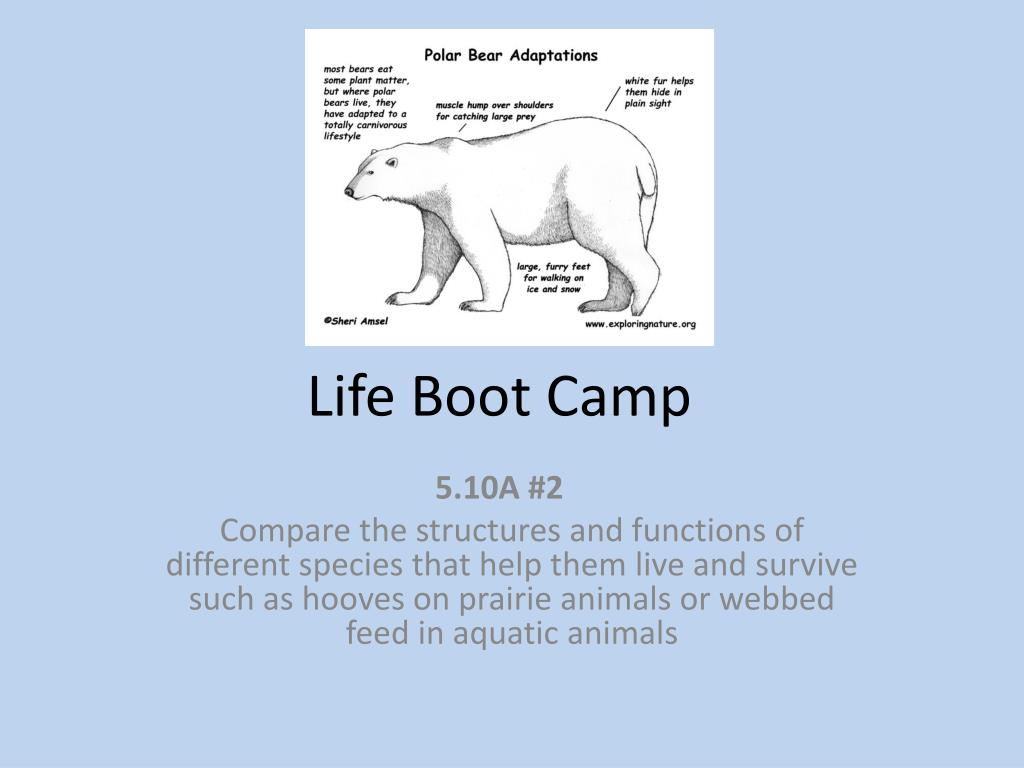
Life Boot Camp. 5.10A #2 Compare the structures and functions of different species that help them live and survive such as hooves on prairie animals or webbed feed in aquatic animals.
Une image / un lien ci-dessous est fourni (tel quel) pour télécharger la présentation
Politique de téléchargement : le contenu du site vous est fourni TEL QUEL pour votre information et votre usage personnel ; il ne peut être vendu, concédé sous licence ni partagé sur d’autres sites sans l’accord de son auteur.Le contenu vous est fourni TEL QUEL, pour votre information et votre usage personnel uniquement.Téléchargez la présentation en cliquant sur ce lien.Lors du téléchargement, si vous ne parvenez pas à télécharger une présentation, l’éditeur a peut-être supprimé le fichier de son serveur.Pendant le téléchargement, si vous ne parvenez pas à obtenir une présentation, le fichier a peut-être été supprimé par l’éditeur.
F I N
Plus de contenu associé
Transcription de la présentation
Life Boot Camp 5.10A #2 Compare the structures and functions of different species that help them live and survive such as hooves on prairie animals or webbed feed in aquatic animals
55. Polar bears have thick, white hair. What advantage does that give the polar bears?A More people will hunt them for their fur.B They look bigger and impress their enemies.C They hunt better and can catch more food.D They stay warmer in very cold climates.
55. Polar bears have thick, white hair. What advantage does that give the polar bears?A More people will hunt them for their fur.B They look bigger and impress their enemies.C They hunt better and can catch more food.D They stay warmer in very cold climates.
57. Animals have adaptations that help them survive. One example of this is the hawk’s strong talons. What primary purpose does this adaptation serve?A Protection from predatorsB Catching and eating foodC Increased flying speedD Protection from prey
57. Animals have adaptations that help them survive. One example of this is the hawk’s strong talons. What primary purpose does this adaptation serve?A Protection from predatorsB Catching and eating foodC Increased flying speedD Protection from prey
58. Which of the following is an example of an adaptation of an animal’s body that would improve its chances of survival in a specific environment?A An armadillo digging a hole under a fenceB A chameleon changing colors to hide from a predatorC Geese flying in a V formationD A gibbon swinging from branch to branch to escape a predator
58. Which of the following is an example of an adaptation of an animal’s body that would improve its chances of survival in a specific environment?A An armadillo digging a hole under a fenceB A chameleon changing colors to hide from a predatorC Geese flying in a V formationD A gibbon swinging from branch to branch to escape a predator
59. Armadillos and coral snakes both live in Texas. When an armadillo is threatened, it curls its armored body up like a ball. A coral snake curls its tail into a tight spiral and holds it up when an enemy is near. Although these animals are very different, what is one way in which they are similar? A They both live in the water.B They have hard outer coverings.C They have ways to protect themselves.D They attack their enemies with poison.
59. Armadillos and coral snakes both live in Texas. When an armadillo is threatened, it curls its armored body up like a ball. A coral snake curls its tail into a tight spiral and holds it up when an enemy is near. Although these animals are very different, what is one way in which they are similar? A They both live in the water.B They have hard outer coverings.C They have ways to protect themselves.D They attack their enemies with poison.
60. The flowers that grow on the floor of a tropical forest have long stems. How does this adaptation help them survive in their environment? Long stems—A protect them from getting too hotB make it easier for them to get sunlightC prevent them from being eatenD make it easier to pull them up
60. The flowers that grow on the floor of a tropical forest have long stems. How does this adaptation help them survive in their environment? Long stems—A protect them from getting too hotB make it easier for them to get sunlightC prevent them from being eatenD make it easier to pull them up
62. Since all living things need nutrients (food) in order to survive, why can plants survive in a clear, closed system but animals cannot?A Plants are not living things, but animals are.B Plants can make their own food, but animals cannot.C Plants can live for long periods of time without nutrients.D Plants take in and give off oxygen, but animals do not.
62. Since all living things need nutrients (food) in order to survive, why can plants survive in a clear, closed system but animals cannot?A Plants are not living things, but animals are.B Plants can make their own food, but animals cannot.C Plants can live for long periods of time without nutrients.D Plants take in and give off oxygen, but animals do not.
63. A green tree frog lives in a forest. How does the frog's green color help it to survive?A By helping the frog find other frogsB By keeping the frog coolC By making the frog hard to see when sitting on leavesD By allowing the frog to make its own food
63. A green tree frog lives in a forest. How does the frog's green color help it to survive?A By helping the frog find other frogsB By keeping the frog coolC By making the frog hard to see when sitting on leavesD By allowing the frog to make its own food
64. What advantage does the walking stick pictured above have for survival in its environment?A It lives on leaves and tree branches.B It blends in with its environment.C It eats the leaves from plants.D It sheds its skin every year.
64. What advantage does the walking stick pictured above have for survival in its environment?A It lives on leaves and tree branches.B It blends in with its environment.C It eats the leaves from plants.D It sheds its skin every year.
65. The cactus plant shown above lives in a desert environment. What characteristic of this plant could be found in many other desert plants?A A deep root system for gathering waterB Lush growth that serves to trap water if it rainsC Broad leaves that protect the plants from the hot sunD Leaves and stems that are adapted to conserve water
65. The cactus plant shown above lives in a desert environment. What characteristic of this plant could be found in many other desert plants?A A deep root system for gathering waterB Lush growth that serves to trap water if it rainsC Broad leaves that protect the plants from the hot sunD Leaves and stems that are adapted to conserve water
66. Animals have adaptations that help them survive in their environment. One example of this is the giraffe’s long neck. What primary purpose does this adaptation serve?A Protection from heatB Gathering of foodC Protection from predatorsD Increased speed
66. Animals have adaptations that help them survive in their environment. One example of this is the giraffe’s long neck. What primary purpose does this adaptation serve?A Protection from heatB Gathering of foodC Protection from predatorsD Increased speed
67. A hover fly looks like a honey bee. Which statement BEST explains how this adaptation helps the hover fly survive? Looking like a honey bee—A keeps other animals away from the hover fly’s foodB keeps other animals away from the hover fly’s homeC allows the hover fly to blend in with its environmentD keeps some predators from trying to eat the hover fly honey bee hover fly
67. A hover fly looks like a honey bee. Which statement BEST explains how this adaptation helps the hover fly survive? Looking like a honey bee—A keeps other animals away from the hover fly’s foodB keeps other animals away from the hover fly’s homeC allows the hover fly to blend in with its environmentD keeps some predators from trying to eat the hover fly honey bee hover fly
68. What is the primary function of the large leaves found on seedlings growing in a forest?ATo provide shade for the root systemsB To get rid of excess water that is entering through the rootsC To allow for leaf damage by insectsD To gather as much light as possible for photosynthesis
68. What is the primary function of the large leaves found on seedlings growing in a forest?ATo provide shade for the root systemsB To get rid of excess water that is entering through the rootsC To allow for leaf damage by insectsD To gather as much light as possible for photosynthesis
69. Barnacles and corals are two types of animals that live in the ocean. Both animals build a hard layer of calcium around their soft body parts. What is the MOST likely reason that they build these layers?A Prepare them for reproductionB Protect them from predatorsC Help them capture foodD Keep them from drying out
69. Barnacles and corals are two types of animals that live in the ocean. Both animals build a hard layer of calcium around their soft body parts. What is the MOST likely reason that they build these layers?A Prepare them for reproductionB Protect them from predatorsC Help them capture foodD Keep them from drying out
72. Coyotes have good eyesight, keen hearing, and an excellent sense of smell. How would these characteristics BEST help a coyote survive in its environment? These characteristics would help—A insulate a coyoteB a coyote moveC the coyote hunt its preyD the coyote eat its food
72. Coyotes have good eyesight, keen hearing, and an excellent sense of smell. How would these characteristics BEST help a coyote survive in its environment? These characteristics would help—A insulate a coyoteB a coyote moveC the coyote hunt its preyD the coyote eat its food
74. Why do large trees have a difficult time living in the tundra?A A tundra is too hot for trees to grow large.B Animals that live in a tundra destroy most vegetation.C Flooding occurs too often in a tundra for large trees to grow.D The soil in a tundra is too frozen for large trees to grow.
74. Why do large trees have a difficult time living in the tundra?A A tundra is too hot for trees to grow large.B Animals that live in a tundra destroy most vegetation.C Flooding occurs too often in a tundra for large trees to grow.D The soil in a tundra is too frozen for large trees to grow.