The Sonnet
The sonnet is a celebrated poetic form, cherished by renowned English poets for centuries. Traditionally comprised of fourteen lines, it often culminates in a rhyming couplet. Sonnets have distinct rhyme schemes, including the Shakespearean (ABAB CDCD EFEF GG), Spenserian (ABBA CDDC EFG EFG), and Italian (ABBA ABBA CDE CDE). Typically written in iambic pentameter, the sonnet features a rhythm of unstressed and stressed syllables. A pivotal thematic shift often occurs in the closing couplet, enriching the poem's emotional depth and meaning.

The Sonnet
E N D
Presentation Transcript
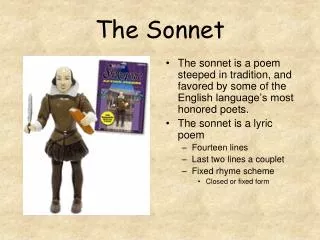
The Sonnet • The sonnet is a poem steeped in tradition, and favored by some of the English language’s most honored poets. • The sonnet is a lyric poem • Fourteen lines • Last two lines a couplet • Fixed rhyme scheme • Closed or fixed form
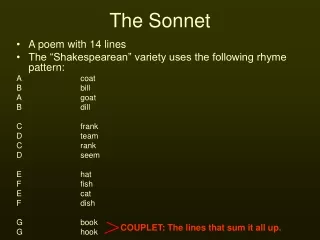
Sonnet Features • Rhyme scheme: • Shakespearean: ABAB CDCD EFEF GG • Spenserian: ABBA CDDC EFG EFG • Italian: ABBA ABBA CDE CDE • ABBA ABBA CED CED • ABBA ABBA CD CDCD
Shakespearian Sonnet Features • Pattern is similar to a heartbeat • weakSTRONGweakSTRONGweakSTRONG • The Shakespearian sonnet is broken up into quatrains and ends with a rhyming couplet
Sonnet Features • The meter of a sonnet is iambic pentameter—that’s a meter with five sets of iambs, or syllable pairs that follow an unstressed syllable by a stressed syllable. • The “shift” in a sonnet usually comes in the final rhyming couplet. Shall I compare thee to a summer rose? Check out how iambic pentameter works!