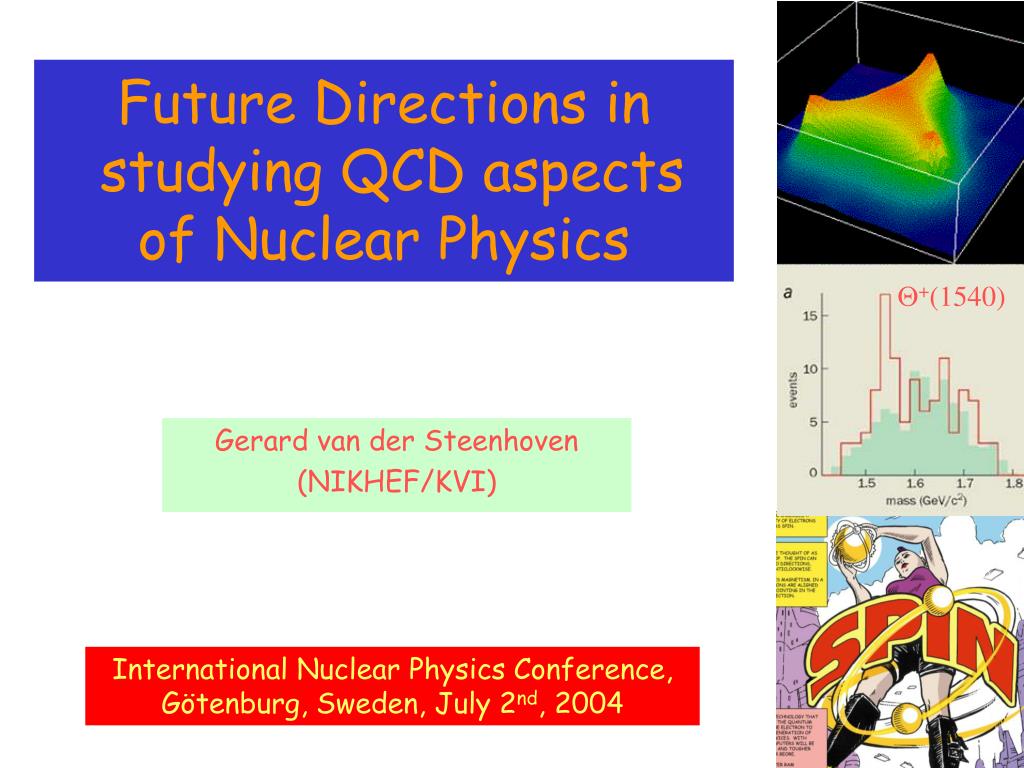
Future Directions in studying QCD aspects of Nuclear Physics. + (1540). Gerard van der Steenhoven (NIKHEF/KVI). International Nuclear Physics Conference, Götenburg, Sweden, July 2 nd , 2004. What remains to be discovered ? (*). WMAP satellite: 70% dark energy 25% dark matter
01 / 66Future Directions in studying QCD aspects of Nuclear Physics
1 / 17
Télécharger la présentation
Future Directions in studying QCD aspects of Nuclear Physics
Une image / un lien ci-dessous est fourni (tel quel) pour télécharger la présentation
Politique de téléchargement : le contenu du site vous est fourni TEL QUEL pour votre information et votre usage personnel ; il ne peut être vendu, concédé sous licence ni partagé sur d’autres sites sans l’accord de son auteur.Le contenu vous est fourni TEL QUEL, pour votre information et votre usage personnel uniquement.Téléchargez la présentation en cliquant sur ce lien.Lors du téléchargement, si vous ne parvenez pas à télécharger une présentation, l’éditeur a peut-être supprimé le fichier de son serveur.Pendant le téléchargement, si vous ne parvenez pas à obtenir une présentation, le fichier a peut-être été supprimé par l’éditeur.
What remains to be discovered ?(*) • WMAP satellite: • 70% dark energy • 25% dark matter • 5% visible matter • The task of LHC: • Unravel the Higgs Mechanism ~ 2% of the visible universe • The task of QCD nuclear physics: → Unravel the origin of 98% of the mass of the visible universe (*) After: J. Maddox, What Remains to be Discovered?, XXXX Press, 2000
The QCD structure of the nucleon • Lattice QCD calculations: • Deep-Inelastic Scattering: (From: G. Bali, Glasgow) The nucleon contains a large amount of quark-antiquark pairs and gluons. gluon Quark-antiquark pair
The challenges of QCD • Extrapolate s to the size • of the proton, 10-15 m: • For s > 1 perturbative expansions fail……… • Non-perturbative QCD: • Proton structure & spin • Confinement • Nucleon-Nucleon forces • Hadron spectroscopy….. Lattice QCD simulations…
Future directions • Hadronic form factors • Transition to pQCD, strangeness • Hadron spectroscopy • Pentaquarks, hybrids, glueballs,... • Spin structure • Gluons, transversity • Generalized parton distributions • Partonic correlations, orbital motion • Future facilities MAMI-C
1. Hadronic Form Factors • Physics issues: • Proton: new data onGEp(Q2)/GMp(Q2) • Pion: transition to pQCD? • Axial form factors: role strangeness in proton • Kaon and hyperon form factors: hadron size • Relevant new facilities: • MAMI-C…………………… 2005 • 12 GeV @ JLab …………. 2010 • PAX @ GSI ……………… 2012 (Letter of Intend)
Time-Like Form Factors • Measure single-spin asymmetry in : → Relative phase ofGMandGE • Entirely new concept: (F. Rathmann et al., LOI – 2004) Polarized anti-protons in the HESR ring @ FAIR: - The PAX project -
2. Hadron spectroscopy Harvest in 2003: • Allowed multi-q states in QCD: • states mesons • states baryons • states pentaquarks? Discovery Discovery CLAS Discovery
New Narrow DsJ-states • BaBar studied decay • Two new mesons ? • The K+K-+-spectrum: 1+ @ 2.46 GeV 0+ @ 2.32 GeV
New charmed baryons • SELEX experiment at FermiLab (E781) • 600 GeV/c π/Σ beam • Decay schematic: • Discoveries:
New narrow S=+1 states Chiral-Soliton mod. prediction in 1997 by Diakonov, Petrov and Polyakov (97): Spring-8 H1 NA49
PANDA @ FAIR* : pellet target, particle ID, ~4 (*) Facility for Anti-proton and Ion Research
3. Search the carriers of proton spin • Three possible sources: • quarks: • valence quarks • sea quarks • gluons • orbital momentum • Mathematically: ½ = ½ Sq + DG + Lq EMC: q ~ 10% ~ 20 10 % ? ?
How to probe the quark polarization? Polarized deep inelastic electron scattering Measure yield asymmetry: Parallel electron & proton spins Anti-parallel electron & proton spins In the Quark-Parton Model: Spin-dependent Structure Function
Polarized Parton Densities • First moments: • input scale • pol. singlet density: • pol. gluon density: There must be other sources of angular momentum in the proton
Future data on and • Assume 400 pb-1 collected at e-RHIC: Domains of existing precision data
Flavour decomposition of spin • Semi-inclusive deep inelastic lepton scattering • Hadron tags flavour of struck quark • Derive purity of tag from unpolarized data Key issue: role of sea quarks in nucleon spin
Sea quark polarization • Up and down quarks haveopposite spins • Sea is unpolarized... • First dataon : [HERMES, hep-ex/0307064] Chiral Quark Soliton Model
First COMPASS data • Tagging of D*→D0: • y-axis: MK - MK - m • x-axis: MK - mD0 80% 2002 data 317 D0 MKp -mD0 [MeV/c2]
or photon or or (heavy flavor) or Gluon Polarization at RHIC • Longitudinal double spin asymmetry in : • Dominant processes: Direct photon production Di-jet production
What is transversity? transverse quark spin, dS • Three leading order quark distributions: momentum carried by quarks longitudinal quark spin,DS • Gluons don’t contribute toh1(x) - dominant in g1(x): • Study nucleon spin while switching off the gluons • New QCD tests: Q2evolution h1(x); dS > DS(lattice)
Measuring transversity - + quark flip target flip - + • The relevant diagram: • helicity flip of quark & target • chirally odd process • Consequences: • no gluon contributions…. … & measure single-spin asymmetries:
Single – Spin Asymmetries • Sivers effect: AUT driven by orbital motion struck quark: measure L • Collins effect: AUT driven by fragmentation process: measure transversity
Future options - COMPASS • First results based on 2002 data • Future: • Particle ID, more statistics, data on AUT for Collins/Sivers • Comparison HERMES data: measure Q2 evolution
l+ q2=M2 l- q qT p p qL Future options - PAX FAIR@GSI • Polarized antiproton beam x polarized target: • Double transverse spin asymmetry: • Key issue: amount of -polar.: • Concept proven in FILTEX exp. • Separate -ring being studied Panda anti-P
4. Generalized Parton Distributions • Consider exclusive processes: • Deeply virtual Compton scatt. • Exclusive vector meson prod. • Collins et al. proved factorization theorem (1997): GPD Distribution amplitude (meson) final state Hard scattering coefficient (QCD) Generalized Parton Distribution (GPD) (Nasty: x = xBj for quarks and x = -xBj for antiquarks → x [-1,1])
GPDs give access toOrbital Angular Momentum of Quarks The remarkable properties of GPDs • Integration over x gives Proton Form Factors: Dirac Axial vector Pauli Pseudoscalar • The forward limit: • Second moment (X. Ji, PRL 1997):
Applying the GPD framework • GPDs enter description of different processes: • Take Fourier transform of leading GPD: As Jq = ½q + Lqinformation on Jqgives data on Lq. GPDs Spatial distribution of quarks in the perpendicular direction