Modeling Turbulent Flows
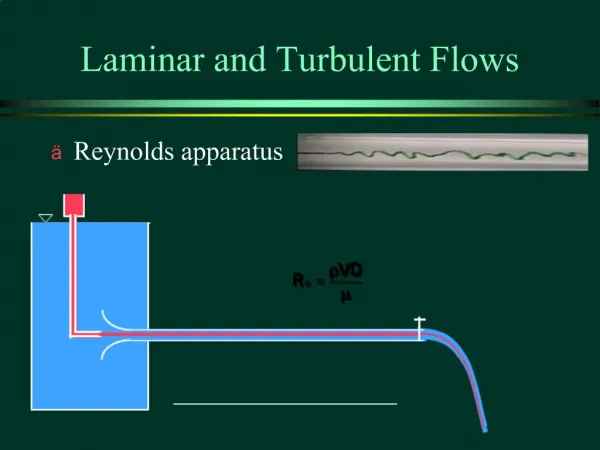
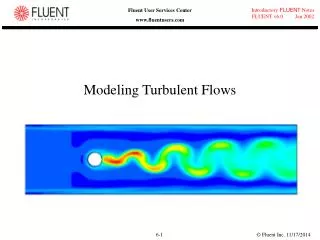
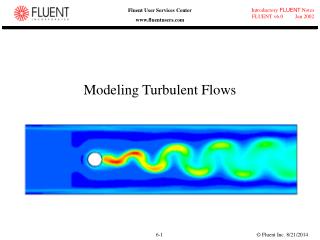
Modeling Turbulent Flows. What is Turbulence?. Unsteady, irregular (aperiodic) motion in which transported quantities (mass, momentum, scalar species) fluctuate in time and space Identifiable swirling patterns characterizes turbulent eddies.

Modeling Turbulent Flows
E N D
Presentation Transcript
What is Turbulence? • Unsteady, irregular (aperiodic) motion in which transported quantities (mass, momentum, scalar species) fluctuate in time and space • Identifiable swirling patterns characterizes turbulent eddies. • Enhanced mixing (matter, momentum, energy, etc.) results • Fluid properties exhibit random variations • Statistical averaging results in accountable, turbulence related transport mechanisms. • This characteristic allows for Turbulence Modeling. • Wide range in size of turbulent eddies (scales spectrum). • Size/velocity of large eddies on order of mean flow. • derive energy from mean flow
Is the Flow Turbulent? External Flows where along a surface L = x, D, Dh, etc. around an obstacle Other factors such as free-stream turbulence, surface conditions, and disturbances may cause earlier transition to turbulent flow. Internal Flows Natural Convection where
Choices to be Made Flow Physics Computational Resources Turbulence Model & Near-Wall Treatment Computational Grid Turnaround Time Constraints Accuracy Required
Modeling Turbulence • Direct numerical simulation (DNS) is the solution of the time-dependent Navier-Stokes equations without recourse to modeling. • Mesh must be fine enough to resolve smallest eddies, yet sufficiently large to encompass complete model. • Solution is inherently unsteady to capture convecting eddies. • DNS is only practical for simple low-Re flows. • The need to resolve the full spectrum of scales is not necessary for most engineering applications. • Mean flow properties are generally sufficient. • Most turbulence models resolve the mean flow. • Many different turbulence models are available and used. • There is no single, universally reliable engineering turbulence model for wide class of flows. • Certain models contain more physics that may be better capable of predicting more complex flows including separation, swirl, etc.
Modeling Approaches • ‘Mean’ flow can be determined by solving a set of modified equations. • Two modeling approaches: • (1) Governing equations are ensemble or time averaged (RANS-based models). • Transport equations for mean flow quantities are solved. • All scales of turbulence are modeled. • If mean flow is unsteady, Dt is set by global unsteadiness. • (2) Governing equations are spatially averaged (LES). • Transport equations for ‘resolvable scales.’ • Resolves larger eddies; models smaller ones. • Inherently unsteady, Dt set by small eddies. • Resulting models requires more CPU time/memory and is not practical for the majority of engineering applications. • Both approaches requires modeling of the scales that are averaged out.
u u'i U Ui ui t RANS Modeling - Ensemble Averaging • Imagine how velocity, temperature, pressure, etc. might vary in a turbulent flow field downstreamof a valve that has beenslightly perturbed: • Ensemble averaging may be used to extract the mean flow properties from the instantaneous properties. n identifies the ‘sample’ ID
Deriving RANS Equations • Substitute mean and fluctuating velocities in instantaneous Navier-Stokes equations and average: • Reynolds Averaged Navier-Stokes equations: whereare the Reynolds Stresses. • The transported variables, U,r, p, etc., now represent the mean flow quantities • The Reynolds Stress terms are modeled using functions containing empirical constants and information about the mean flow.
Modeling the Reynolds Stresses • The RANS based turbulence models calculate the Reynolds Stresses by one of two methods: • (1) Using the Boussinesq assumption, the Reynolds stresses are related to the mean flow by a turbulent viscosity, mt: • Strain rate tensor, Sij, described in terms of mean flow. • Isotropic viscosity assumed • (2) Solving individual transport equations for the Reynolds stresses. • Turbulent viscosity is not employed, no assumption of isotropy • Contains more “physics” • More complex and computationally expensive than (1) 2Sij
Calculating mt for Boussinesq Formula • Based on dimensional arguments, mt can be determined from the conservative variables k, e or w. • is the turbulent kinetic energy • is the dissipation rate of k (to thermal energy) • is the specific dissipation rate • mt is calculated differently depending upon the turbulence model. • Spalart-Allmaras • This ‘single equation’ model solves one additional transport equation for a modified viscosity. • Standard k-e, RNG k-e, Realizable k-e • These ‘two equation’ models solve transport equations for k and e. • Standard k-w, SST k-w • These ‘two equation’ models solve transportequations for k and w.
Example: Fluent’s Standard k- Model • Transport equation for k: • Transport equation for e: • Turbulent viscosity: • are empirically defined constants. • Turbulence modeling options account for: • viscous heating (in energy equation) • compressibility effects, YM (activated when ideal gas is used) • buoyancy, Gb • user defined sources, Sk and Se
Pressure/velocity fluctuations Molecular transport Turbulent transport Example: Fluent’s Reynolds Stress Model • Transport equation for Rij: • Generation: • Pressure-StrainRedistribution: • Dissipation: • Diffusion: (computed) (modeled) (related to e) (modeled)
Turbulence Models in Fluent RANS-based models Zero-Equation Models One-Equation Models Spalart-Allmaras Two-Equation Models Standard k-e RNG k-e Realizable k-e Standard k-w SST k-w Reynolds-Stress Model Large-Eddy Simulation Direct Numerical Simulation Increase Computational Cost Per Iteration Available in FLUENT 6
Large Eddy Simulation (LES) • Motivation: • Large eddies: • Mainly responsible for transport of momentum, energy, and other scalars, directly affecting the mean fields. • Anisotropic, subjected to history effects, and flow-dependent, i.e., strongly dependent on flow configuration, boundary conditions, and flow parameters. • Small eddies tend to be more isotropic, less flow-dependent, and hence more amenable to modeling. • Approach: • LES resolves large eddies and models only small eddies. • Equations are similar in form to RANS equations • Dependent variables are now spatially averaged instead of time averaged. • Large computational effort • Number of grid points, NLES • Unsteady calculation
Problem Setup for LES • Small eddies defined by grid cell size. • Good starting point for cell size is Taylor length scale, l (10nk/e)1/2. • You can use a two-equation model on coarse mesh to determine range of k and e. • Time step size can be defined by: tl/U. • Effective stress requires definition of Subgrid Scaleviscosity. • Smagorinsky-Lilly model • constant Cs must be tuned to flow • RNG-based model • Useful for low Re flows where mt m • Post-processing • Statistically time averaged results are available.
y+ u+ Modeling the Near-Wall Region • Accurate near-wall modeling is important for most engineering applications. • Successful prediction of frictional drag, pressure drop, separation, etc., depends on fidelity of local wall shear predictions. • Most k-e and RSM turbulence models will not predict correct near-wall behavior if integrated down to the wall. • Problem is the inability to resolve e. • Special near-wall treatment is required. • Standard Wall Functions • Non-Equilibrium Wall Functions • Enhanced wall treatment • S-A and k-w models are capable ofresolving the near-wall flow provided near-wall mesh is sufficient.
outer layer inner layer Near-Wall Modeling Options • In general, ‘wall functions’ are a collection or set of laws that serve as boundary conditions for momentum, energy, and species as well as for turbulence quantities. • Wall Function Options • The Standard and Non-equilibrium Wall Function options refer to specific ‘sets’ designed for high Re flows. • The viscosity affected, near-wall region is not resolved. • Near-wall mesh is relatively coarse. • Cell center information bridged by empirically-based wall functions. • Enhanced Wall Treatment Option • This near-wall model combines the use of enhanced wall functions and a two-layer model. • Used for low-Re flows or flows with complex near-wall phenomena. • Generally requires a very fine near-wall mesh capable of resolving the near-wall region. • Turbulence models are modified for ‘inner’ layer.
for where Standard and Non-Equilibrium Wall Functions • Standard Wall Function • Momentum boundary condition based on Launder-Spaulding law-of-the-wall: • Similar ‘wall laws’ apply for energy and species. • Additional formulas account for k, e, and ruiuj. • Less reliable when flow departs from conditions assumed in their derivation. • Severe p or highly non-equilibrium near-wall flows, high transpiration or body forces, low Re or highly 3D flows • Non-Equilibrium Wall Function • SWF is modified to account for stronger p and non-equilibrium flows. • Useful for mildly separating, reattaching, or impinging flows. • Less reliable for high transpiration or body forces, low Re or highly 3D flows. • The Standard and Non-Equilibrium Wall functions are options for the k-e and RSM turbulence models.
Enhanced Wall Treatment • Enhanced Wall Treatment • Enhanced wall functions • Momentum boundary condition based on blendedlaw-of-the-wall (Kader). • Similar blended ‘wall laws’ apply for energy, species, and w. • Kader’s form for blending allows for incorporation of additional physics. • Pressure gradient effects • Thermal (including compressibility) effects • Two-layer model • A blended two-layer model is used to determine near-wall e field. • Domain is divided into viscosity-affected (near-wall) region and turbulent core region. • Based on ‘wall-distance’ turbulent Reynolds number: • Zoning is dynamic and solution adaptive. • High Re turbulence model used in outer layer. • ‘Simple’ turbulence model used in inner layer. • Solutions for e and mt in each region are blended, e.g., • The Enhanced Wall Treatment near-wall model are options for the k-e and RSM turbulence models.
Estimating Placement of First Grid Point • Ability for near-wall treatments to accurately predict near-wall flows depends on placement of wall adjacent cell centroids (cell size). • For SWF and NWF, centroid should be located in log-layer: • For best results using EWT, centroid should be located in laminar sublayer: • This near-wall treatment can accommodate cells placed in the log-layer. • To determine actual size of wall adjacent cells, recall that: • The skin friction coefficient can be estimated from empirical correlations: • Flat Plate- • Pipe Flow- • Use post-processing to confirm near-wall mesh resolution.
Near-Wall Modeling RecommendedStrategy • Use SWF or NWF for most high Re applications (Re > 106) for which you cannot afford to resolve the viscous sublayer. • There is little gain from resolving viscous sublayer (choice of core turbulence model is more important). • Use NWF for mildly separating, reattaching, or impinging flows. • You may consider using EWT if: • The characteristic Re is low or if near wall characteristics need to be resolved. • The same or similar cases ran successfully previously with the two-layer zonal model (in Fluent v5). • The physics and near-wall mesh of the case is such that y+ is likely to vary significantly over a wide portion of the wall region. • Try to make the mesh either coarse or fine enough, and avoid putting the wall-adjacent cells in the buffer layer (y+ = 5 ~ 30).
Setting Boundary Conditions • When turbulent flow enters a domain at inlets or outlets (backflow), boundary values for: • k, ,w and/or must be specified • Four methods for directly or indirectly specifying turbulence parameters: • Explicitly input k, ,w, or • This is the only method that allows for profile definition. • Turbulence intensity and length scale • Length scale is related to size of large eddies that contain most of energy. • For boundary layer flows: l 0.4d99 • For flows downstream of grid: l opening size • Turbulence intensity and hydraulic diameter • Ideally suited for duct and pipe flows • Turbulence intensity and turbulent viscosity ratio • For external flows: 1 <mt/m< 10 • Turbulence intensity depends on upstream conditions:
GUI for Turbulence Models DefineModelsViscous... Inviscid, Laminar, or Turbulent Turbulence Model options Near Wall Treatments Additional Turbulence options
Example: Ship Hull Flow • Experiments: KRISO’s 300K VLCC (1998) • Complex, high ReL (4.6 106) 3D Flow • Thick 3D boundary layer in moderate pressure gradient • Streamline curvature • Crossflow • Free vortex-sheet formation (“open separation”) • Streamwise vortices embedded in TBL and wake • Simulation • Wall Functions used to manage mesh size. • y+ 30 - 80 • Hex mesh ~200,000 cells • Experimentally derived contours of axial velocity
Comparing Contour Plots of Axial Velocity • SKO and RSM models capture characteristic shape at propeller plane. RNG RKE SA RSM SKE SKO
Comparing Wake Fraction and Drag • Though SKO (and SST) were able to resolve salient features in propeller plane, not all aspects of flow could be accurately captured. • Eddy viscosity model • RSM models accurately capture all aspects of the flow. • Complex industrial flows provide new challenges to turbulence models.
Summary: Turbulence Modeling Guidelines • Successful turbulence modeling requires engineering judgement of: • Flow physics • Computer resources available • Project requirements • Accuracy • Turnaround time • Turbulence models & near-wall treatments that are available • Modeling Procedure • Calculate characteristic Re and determine if Turbulence needs modeling. • Estimate wall-adjacent cell centroid y+ first before generating mesh. • Begin with SKE (standard k-) and change to RNG, RKE, SKO, or SST if needed. • Use RSM for highly swirling flows. • Use wall functions unless low-Re flow and/or complex near-wall physics are present.