Solid Phase Peptide Synthesis Using tBoc Chloride and Dicyclohexylcarbodiimide
This article discusses the solid phase synthesis of peptides utilizing tertiary butyloxycarbonyl chloride (tBocCl) for blocking amino groups and dicyclohexylcarbodiimide (DCCD) for activating carboxyl groups. The process involves attaching the carboxyl group of the initial amino acid to an insoluble resin, followed by the addition of subsequent amino acids with the amino groups protected by tBoc. The method facilitates the formation of peptide bonds and enables the recovery of the growing peptide chain through simple filtration or centrifugation.

Solid Phase Peptide Synthesis Using tBoc Chloride and Dicyclohexylcarbodiimide
E N D
Presentation Transcript
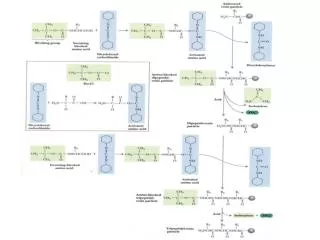
Solid phase syntheses of a peptide.(inset)Tertiary butyloxycarbonyl chloride(tBocCl)is an excellent reagent for blocking amino groups of amino acids during organic synthesis.Dicyclohexylcarbodiimide(DCCD)is a powerful agent for activating carboxyl groups to condense with amino groups to form peptide bonds.The carboxyl group of the first amino acid(the carboxyl-terminal amino acid of the peptide to be synthesized)is attached to an insoluble resin particle(the aminoacyl-resin particle).The next amino acid,with its amino group blocked by a tBoc group and tis carboxyl group activated with DCCD,is reacted with the aminoacyl-resin particle to form a peptide linkage,with elimination of DCCD as dicyclohexylurea.Acid treatment removes the N-terminal tBoc blocking group as the gaseous products CO2 and isobutylene,exposing the N-terminus of the dipeptide for another cycle of amino acid addition.The growing peptide chain is easily recovered after cyclic additions of amino acids simply by filtering or centrifuging the reaction mixture.