Dental Wire Failure Analysis
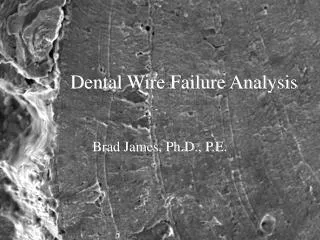
This analysis details the failure of a three-coil dental wire, reportedly made from nitinol, after two months of service. The wire fractured while an eight-year-old patient was eating, fortunately without causing any injury. The study employs fractural mechanics to estimate the loads on the wire, revealing that the material is likely austenitic stainless steel (probably 304) rather than nitinol. Using techniques such as the critical crack length approach and striation spacing evaluation, the report emphasizes high cycle fatigue failure and the need for improved wire quality in orthodontic applications.

Dental Wire Failure Analysis
E N D
Presentation Transcript
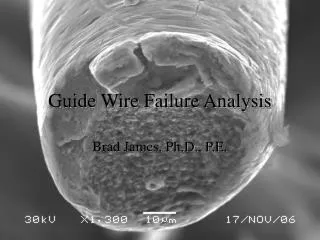
Dental Wire Failure Analysis Brad James, Ph.D., P.E.
Background • Three-coil dental wire had been in service for approximately two months • Orthodontist stated the cables were made of nitinol • Cable fractured while eight year old patient was eating Japanese food • Fortunately, no injury occurred due to fracture
Analysis SEM of as-received wires:
Analysis SEM following cleaning:
Analysis Wire Number 1:
Analysis Wire Number 1:
Analysis Wire Number 2:
Analysis Wire Number 2:
Analysis Wire Number 3:
Nitinol? Don’t think so…..
Use Fracture Mechanics to Estimate Wire Loads • Critical crack length approach: • Given KIC, and critical crack length, use K solution to determine the maximum load • Make sure LEFM applies! (crack length, plastic zone size, etc.) • Striation spacing approach: • Determine da/dN and ΔK from striation spacing near final fracture (need da/dN vs. ΔK for material and environment) • Modify ΔK for any R-ratio effects (e.g. Forman equation) • Determine peak load using appropriate K-solution (need crack length at striation measurement location)
Examples of Striation Spacing as a Function of da/dN From: D. L. Davidson and J. Lankford, “Fatigue Crack Growth in Metals and Alloys: Mechanisms and Micromechanics”, International Materials Reviews, 1002, Vol. 37, No. 2, pp. 45-76
Conclusions • High cycle fatigue failure • Non-zero stress ratio, reversed bending stress condition • Wire was austenitic stainless steel (probably 304), not nitinol! • Haven’t gotten around to determining maximum load on wire yet….