SlideServe
Menu
Préférences
© SlideServe · v2026

Mathematical Analysis of Robustness

blytle avatar
13 diapositives · 163 Views · Jan 03, 2020

Mathematical analysis allows linking robustness to network structure, proposing a two-step search for kinetic parameter values, and analyzing robustness without exact parameter values for identifying critical reactions. The approach combines random search and genetic algorithms for exploring plausible solutions. Criteria for exhaustive search include parameter spectrum width and variability. The method is applied to the circadian oscillator model, finding critical reactions and highly robust models to random perturbations.
Mathematical Analysis of Robustness - slide 1
01 / 13Mathematical Analysis of Robustness
1 / 17

Télécharger la présentation

Mathematical Analysis of Robustness
Une image / un lien ci-dessous est fourni (tel quel) pour télécharger la présentation

Politique de téléchargement : le contenu du site vous est fourni TEL QUEL pour votre information et votre usage personnel ; il ne peut être vendu, concédé sous licence ni partagé sur d’autres sites sans l’accord de son auteur.Le contenu vous est fourni TEL QUEL, pour votre information et votre usage personnel uniquement. Téléchargez la présentation en cliquant sur ce lien. Lors du téléchargement, si vous ne parvenez pas à télécharger une présentation, l’éditeur a peut-être supprimé le fichier de son serveur.Pendant le téléchargement, si vous ne parvenez pas à obtenir une présentation, le fichier a peut-être été supprimé par l’éditeur.

F I N

Plus de contenu associé

Transcription de la présentation
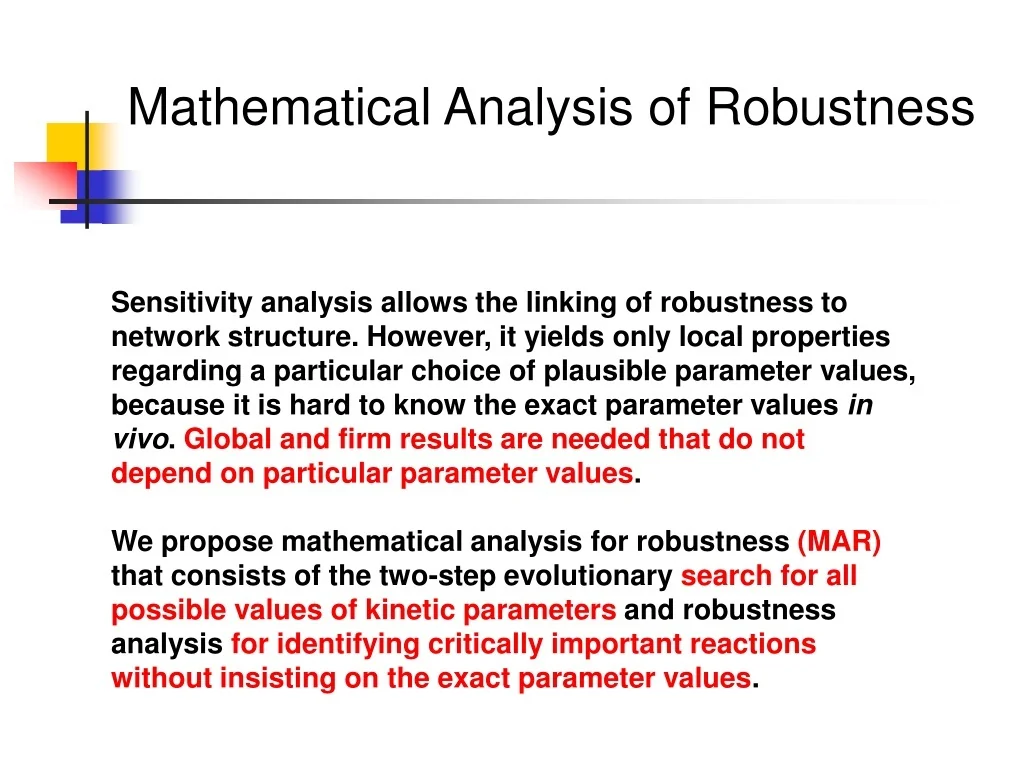
  1. Mathematical Analysis of Robustness Sensitivity analysis allows the linking of robustness to network structure. However, it yields only local properties regarding a particular choice of plausible parameter values, because it is hard to know the exact parameter values in vivo. Global and firm results are needed that do not depend on particular parameter values. We propose mathematical analysis for robustness (MAR) that consists of the two-step evolutionary search for all possible values of kinetic parameters and robustness analysis for identifying critically important reactions without insisting on the exact parameter values.

  2. A flow chart of MAR

  3. Two-step search evolutionary for exhaustive search of all possible kinetic parameter values The two-step evolutionary search that combines a random search with a search by GAs. First, the random search explores a large parameter space to find multiple coarse solutions showing a good fitness value. Second, each initial population for GAs is created around one of the coarse solution vectors. The search by GAs focuses on the space surrounding the coarse solution and is applied to each initial population independently to find plausible solutions that show a high fitness value.

  4. Two criteria of an exhaustive search • Parameter spectrum width • 2. Variability of solution vectors for parameters

  5. Robustness analysis Exploring general features that do not depend on the exact values of kinetic parameters Combining the single parameter sensitivity analysis and the robustness analysis to multiple parameter perturbation enables identifying critical reactions.

  6. Application to the interlocked feedback model of the circadian oscillator A schematic diagram of the interlocked feedback system in the Drosophila circadian clock

  7. Convergence of the two criteria 400 converge 400 converge Convergence for the variability in the solutions of kinetic parameters Convergence of the logarithmic width of the parameter spectrum for 12 search parameters

  8. Classification of kinetic parameters in single parameter sensitivity analysis Use of a threshold value of 10-8 separates the potentially influential parameters. Distributions of period and amplitude sensitivities 400 solutions are used for analysis.

  9. Robustness to multiple parameter random perturbation Frequency distributions of the period and amplitude in a randomly perturbed oscillator model

  10. An appropriate choice of kinetic parameter sets provides a highly robust model to random perturbations to multiple parameters Highly robust Highly robust Frequency of the CVs of period and amplitude distributions in randomly perturbed oscillator models 400 solutions are employed for analysis.

  11. Highly robust Highly robust Highly robust Highly robust Classification of the sensitivity distribution and the parameter vectors Critical parameters (high sensitive) are uniquely determined in highly robust systems, while kinetic parameter values are not.

  12. Identification of critical reactions (high sensitive) in highly robust systems A distribution of the mean absolute sensitivity for period and amplitude in highly robust models The blue and red bars are the period and amplitude sensitivities, respectively.

  13. Conclusion MAR identifies the reactions critically responsible for determining the period and amplitude in the interlocked feedback model and suggests that the circadian clock intensively evolves or designs the kinetic parameters so that it creates a highly robust cycle.