
Hazardous Chemicals: Pollution & Prevention
E N D
Presentation Transcript
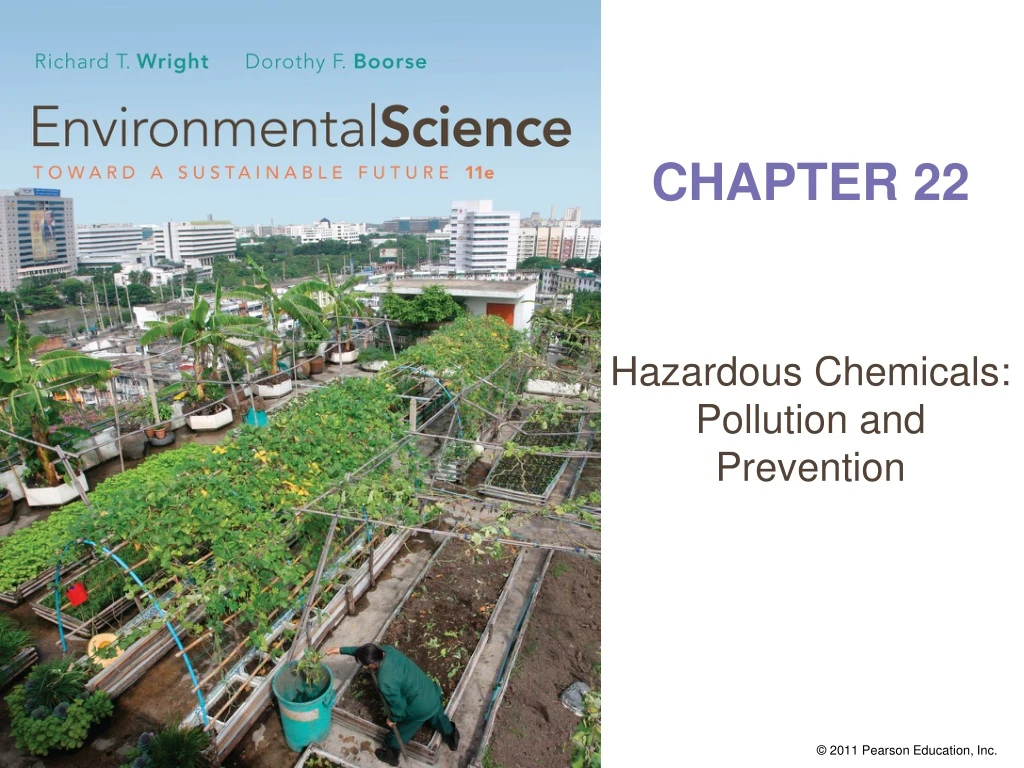
CHAPTER 22 Hazardous Chemicals: Pollution and Prevention
An introduction to hazardous chemicals • Fish in Lake LeBarge, Canada, have become hazardous to eat because of high DDT levels • Arctic fish, birds, and mammals have high amounts of persistent organic pollutants (POPs) in their bodies • DDT, toxaphene, chlordane, PCPs, dioxins • The Inuit people have very high loads of POPs • How do these toxic chemicals reach remote areas? • There are no pesticides or industries
Chemicals in remote areas • POPs are persistent, bioaccumulate, and biomagnify • They are carried to the Arctic in the air • They condense on the snowpack and enter water during the spring thaw • Plankton pick up the chemicals and pass them up the food chain • Highest amounts are in Arctic ponds near seabird nests • Feeding birds concentrate the chemicals, which are deposited to the land and water in guano
Human exposure to chemicals • Three-fourths of Inuit women have PCB levels 5 times above safe levels • Caribou pick up dioxins in lichens and mosses • The Inuit eat the caribou • Some POPs are declining in the Arctic • Others are increasing and accumulating in polar bears, seals, and foxes • E.g., polybrominated diphenyl ethers—PBDEs • Effects include immune-system disorders, hormone disruptions, cancer, imbalances in births
Dangers of chemicals • Significant dangers are associated with manufacture, use, disposal of many chemicals • Few people want to give up their products • The best solution? • Handle and dispose of chemicals in ways that minimize risks • Over the past 30 years, regulations on chemical production, transport, use, and disposal have mushroomed • The chemical industry is now heavily regulated
Toxicology and chemical hazards • Toxicology: the study of the harmful effects of chemicals on human and environmental health • Toxicologists study acute toxicity effects, chronic effects, and carcinogenic potential • Data on toxic chemicals comes from • The National Toxicology Program (NTC) • The Chemical Repository • The National Institute of Environmental Health Sciences (NIEHS) • The EPA’s Integrated Risk Information System (IRIS)
Dose response and threshold • The dose (level of exposure multiplied by the length of time of exposure) is linked with the response (effects) • If a chemical has a low toxicity, concern centers on chronic or carcinogenic effects • Human exposure to a hazard is a vital part of risk characterization • Exposure comes from the workplace, food, water, and environment • It is hard to get an accurate determination of exposure
Threshold level • There is usually a threshold level in the dose-response relationship • Organisms can usually deal with some level of a substance without suffering ill effects • Threshold level: the level below which there are no ill effects • Effects above this level depend on concentration and duration of exposure • It is high for short exposures, and lower as time increases
Threshold levels for carcinogens • The EPA takes a zero-dose, zero-response approach for carcinogens • There is no evidence of a threshold level for them • But lower doses are less likely to produce cancers • The field of toxicology is well established • It is the most important source of sound science for supporting regulations from the EPA and FDA • The NTP was established in 1978 • The world’s leader in assessing chemical toxicity and carcinogenicity
Chemical hazards: HAZMATS • Hazardous material (HAZMAT): a chemical that presents a certain hazard or risk (excluding radioactive materials) • Ignitability: substances that catch fire readily (gasoline) • Corrosivity: substances that corrode tanks and equipment (acids) • Reactivity: chemically unstable substances • May explode or create toxic fumes if mixed with water (explosives, sulfuric acid) • Toxicity: substances that are injurious when eaten or inhaled (chlorine, pesticides, etc.)
Sources of chemicals • Total product life cycle: encompasses all steps in a material’s life from raw materials to disposal • Chemical wastes and by-products are inevitable • Over 80,000 chemicals are registered in the U.S. • They enter the environment at every stage • Chemicals enter the environment directly (e.g., fertilizers) • Parts are left behind (e.g., evaporation of solvents) • Through use (e.g., lubricants, solvents) • Through energy use (gasoline, coal, etc.) • Through accidents or spills
Federal legislation • Industry, small shops, and homes release chemicals • Toxic Release Inventory (TRI): provides an annual record of releases of 650 chemicals by 22,000 facilities • Total releases have declined by 61% since 1990 • The Emergency Planning and Community Right to Know Act (EPCRA—1986) • Industries must report releases of toxic chemicals to the environment • The Pollution Prevention Act (1990): mandates collection of data of chemicals treated on-site
Toxic Release Inventory • Does not cover small businesses that release < 500 lbs/year • Also excludes gas stations and households • Over 3.2 billion lbs/year are released but not included • In 2007, the TRI released the following information: • Total production of toxic wastes: 24.2 billion lbs • Releases to the air: 1,311 million lbs • Releases to water: 237 million lbs • Releases to land disposal sites and underground injection: 2,538 million lbs • Total environmental releases: 4.086 billion lbs
The threat from toxic chemicals • All toxic chemicals are hazards that threaten humans • Many are broken down and assimilated • Two classes do not readily break down: • Heavy metals (lead, mercury, arsenic, cadmium, tin, chromium, zinc, and copper) and their compounds • Synthetic organics • If diluted enough in air or water, they may not pose a hazard
Heavy metals • Are used in industry (metalwork, metal plating), batteries, and electronics • Were once used in paint, glazes, inks, dyes • Lead paint poisoned U.S. children; it was banned in 1978 • Heavy metals are extremely toxic • They can be soluble in water • If absorbed in the body, they interfere with enzyme functioning • Small amounts can cause severe consequences • Mental retardation, insanity, birth defects
Organic compounds • Petroleum-derived and synthetic organics are the basis for plastics, fibers, synthetic rubber, paintlike coatings, solvents, pesticides, preservatives, etc. • Resistance to degradation makes them useful and dangerous • Are readily absorbed and interact with enzymes • But they cannot be broken down or processed • Acute effects: poisoning, death • Extended exposure leads to mutagenic, carcinogenic, teratogenic (causing birth defects) effects • Liver and kidney dysfunction, sterility, etc.
Dirty dozen • Halogenated hydrocarbons: synthetic organics that contain halogens: chlorine, bromine, fluorine, iodine • Chlorinated hydrocarbons (organic chlorides): the most common halogenated hydrocarbons • Plastics, pesticides (DDT), solvents (carbon tetrachloride), insulation (polychlorinated biphenyls) • Most “dirty dozen” POPs are halogenated hydrocarbons • All are toxic and cause cancer in animals • Many are endocrine disrupters at low levels • Banned or restricted by the 2004 Stockholm Convention
PERC • Perchloroethylene (PERC): a halogenated hydrocarbon • Colorless, nonflammable • Used in dry cleaning, as a solvent, in home products • Is carcinogenic to rats and mice • It easily enters groundwater from soil • Human exposure occurs in the workplace and from using home products • Dizziness, fatigue, headaches, unconsciousness, cancer • It is listed in NTP’s 2009 Report on Carcinogens as “reasonably anticipated to be a human carcinogen”
Phasing out PERC • Dry-cleaning employees have higher rates of cancer and neurological impairment • EPA issued rules to phase it out by 2020 • Why is it taking so long? • The Obama administration will review these rules • The U.S. uses 370 million lbs/year • 10% from dry cleaners • The rest is used in making hydrofluorocarbons (which replace ozone-depleting CFCs)
Issues with other organics • Phthalates: soften plastic (e.g., teethers, rubber duckies) • A possible reproductive hormone disrupter • It was banned in 2008 from children’s toys • Bisphenol A (BPA): used in plastics (e.g., baby bottles) • In animals: obesity, diabetes, infertility, cancer • 2008: the FDA declared it did not pose a health hazard • An FDA scientific advisory panel said the ruling was flawed
Another organic • Perchlorate: in rocket fuel and other flammable products • Now in drinking water and food • Found in every brand of powdered infant formula tested • Interferes with thyroid gland function • The EPA refused to set a drinking water standard in 2008 • 20 million Americans are exposed to unsafe levels • Bush administration regulatory agencies chose lax or no rules for regulating controversial chemicals • The EPA also weakened TRI reporting rules • Obama favors stricter rules and regulations
Involvement with food chains • Heavy metals and nonbiodegradable synthetic organics are hazardous because they bioaccumulate • Minamata disease occurred in Japan in the 1970s • A chemical company near the village discharged mercury into a river, which entered the bay • Mercury bioaccumulated and biomagnified • Cats fed fish suffered acute mercury poisoning: spastic movements, paralysis, coma, and death • Humans eating fish suffered the same symptoms, plus mental retardation, insanity, and birth defects; 50 died
Hazardous-waste disposal • The Clean Air and Clean Water Acts ended disposal of hazardous wastes into the air and water • So companies turned to unregulated land disposal • Three land disposal methods were used in the 1970s • Without regulations or enforcement, groundwater contamination was inevitable • Deep-well injection: boreholes are drilled thousands of feet below groundwater into porous formations • A well contains pipes and casings that isolate wastes • The well is sealed at the bottom to prevent backup
Deep-well injection • Wastes in wells react with natural material, leaving them less hazardous • Used for volatile organics, pesticides, fuels, explosives • 121 wells operate in the U.S. • Mostly in the Gulf Coast region • The EPA’s Underground Injection Control Program • Wells must be limited to geologically stable areas • 203 million lbs in 2007, but amounts have decreased • Wells can keep toxic wastes from contaminating water
Surface impoundments • Ponds: excavated depressions into which liquid wastes are drained and held • The least expensive, most widely used way to dispose of large amounts of water carrying small amounts of waste • Solid wastes settle; water evaporates • Impoundments can receive wastes indefinitely if: • The bottom is well sealed • Evaporation equals input of wastes • But storms can cause overflow, and evaporated materials can add air pollution
RCRA • The Resource Conservation and Recovery Act (1996) prompted the EPA to study surface impoundments • The 2007 TRI reported 781 million lbs of toxics released to on-site (disposal by producers on their own facilities) surface impoundments • 18,000 surface impoundments exist at 7,500 facilities • Two-thirds of impoundments contain materials with carcinogenic and other human health concerns • Most impoundments are only a few meters above groundwater, and more than half lack liners
People live near impoundments • Over 20 million live within 1.2 miles of an industrial impoundment • 10% are within 500 feet of a drinking-water well • 2%–5% of sites pose possible risks to human health • 24% pose a risk of release to the environment • Existing state and federal regulations should be enough to cover most impoundment-related problems • Gaps in regulatory coverage exist • Future regulations may be needed
Landfills • RCRA sets standards for disposal of wastes in landfills • Concentrated liquids or solids are put into drums • Best-demonstrated available technologies (BDATs) • Treatment standards for wastes are set by the EPA • Reduce chemical toxicity and mobility • Technologies include stabilization and incineration, chemical oxidation, and other specific techniques • Only 23 landfills in North America receive off-site hazardous wastes • Received 403 million lbs in 2007
Secure landfills • Secure landfill: a reasonably safe landfill that is lined • It also has a leachate-removal system • It is monitored and properly capped • But the barriers are subject to damage and deterioration • Surveillance and monitoring systems are needed to prevent leakage
Mismanagement of hazardous waste • Early land disposal was not regulated • Deep wells injected wastes into groundwater • Abandoned quarries were used as landfills • Surface impoundments had no liners • A new enterprise was created: waste disposal • Many reputable businesses were formed • Midnight dumping: disreputable businesses pocketed fees, then illegally dumped wastes in abandoned warehouses, vacant lots, or landfills • The individuals responsible could not be found
Orphan sites • Orphan sites: some companies or individuals stored wastes on their own property, then went out of business, abandoning the property and wastes • Leaking drums could cause explosions and fires • Valley of the Drums (VOD): in Kentucky • One of the most famous abandoned sites • Love Canal, New York: brought the problem of unregulated dumping to the public’s attention • The absence of public policy made the situation worse
Love Canal • A school and houses were built on top of a chemical waste dump • The surface collapsed, exposing barrels of chemical wastes • Fumes and chemicals seeped into cellars • People suffered birth defects and miscarriages • People demanded that the state do something • President Carter signed an emergency declaration in 1978 to relocate hundreds of residents • The school closed and homes were demolished
Occidental • Hooker Chemical and Plastics Company purchased an abandoned canal near Niagara Falls in 1942 • It filled the canal with 21,000 tons of hazardous waste • Hooker covered the canal with a clay cap and sold it to the school board after warning the board about the buried chemicals • Construction penetrated the cap, and rain leached chemicals • Occidental Petroleum (the parent company) paid $233 million on the cleanup and lawsuits
Bad disposal practices were rampant • In the 1980s, the U.S. had 75,000 active industrial landfill sites, 180,000 surface impoundments, and 200 facilities that could contaminate groundwater • Most were small, but the total problem was immense • Thousands of contaminated water wells were closed • The problem was found only when people got sick • Problems of toxic chemical wastes occur in three areas: • Cleaning up the messes already created • Regulating disposal of wastes being produced • Reducing the quantity of hazardous waste produced
Cleaning up the mess • Contaminated drinking water: a major public health threat • The first priority: ensure that people have safe water • Second: clean up or isolate the pollution’s source to prevent further contamination • The Safe Drinking Water Act (1974): the EPA set national standards to protect public health • Including allowable levels of specific contaminants • Maximum contaminant levels (MCLs): if contaminants exceed this level, the water source is closed • The EPA has jurisdiction over groundwater, too
Groundwater remediation • Groundwater remediation: a developing technology used if toxic materials have contaminated groundwater • Techniques involve drilling wells, pumping out contaminated water, purifying it, and reinjecting it • Cleaning up the source of the water is mandatory • If contamination is severe, remediation may not be possible • Groundwater is considered unfit for drinking
Superfund for toxic sites • The most monumental task we face is cleaning up tens of thousands of toxic sites • Mangers of operating sites were pressured to clean up • Many operators simply declared bankruptcy and abandoned their sites • The Comprehensive Environmental Response, Compensation, and Liability Act (CERCLA; 1980) • Known as Superfund • A trust fund that uses money from taxes on chemical raw materials
CERCLA • The trust pays for identification of sites, protection and remediation of groundwater, and cleanup of sites • Superfund Amendments and Reauthorization Act (SARA; 1986): greatly expands the Superfund program • All sites cannot be cleaned up, so priorities must be set • All sites are identified, and threats to groundwater are determined • If no immediate threat exists, nothing else is done • If a threat exists, measures are taken to protect the public by isolating the wastes