Understanding the Power Problem in Superbubbles: Insights from N44 Observations
210 likes | 326 Vues
This research delves into the complex dynamics of superbubbles, particularly focusing on the N44 region. It highlights the discrepancies in growth rates observed in standard adiabatic models and suggests that input power, ambient density, and pressure might be underestimated. The study explores various possible solutions to these discrepancies, such as overestimating mass loss rates, clumping effects, and cooling mechanisms. By analyzing a broad range of data from different environments, this work aims to provide a comprehensive understanding of superbubble evolution and its implications for cosmic radiation and star formation.


Understanding the Power Problem in Superbubbles: Insights from N44 Observations
E N D
Presentation Transcript
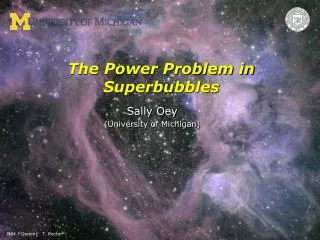
Sally Oey (University of Michigan) The Power Problem in Superbubbles N44 / Gemini: T. Rector
Adiabatic shell evolution L = mech luminosity n = ambient density t = age Pikel'ner (1968); Castor et al. (1975); Dyson (1977) Simulations: Mac Low et al. (1989); Bisnovatyi-Kogan et al. (1989); Palous et al. (1990); Tenorio-Tagle et al. (1990); Tomisaka (1991); Silich et al. (1996); Gazol-Patino & Passot (1999); Strickland & Stevens (2000); others…
X-ray dim X-ray bright Low [S II]/HaHigh [S II]/Ha Comparing to standard adiabatic model The Problem: Growth rate discrepancy observe: R, v, stellar pop R (pc) v (km s-1) L/n reduced 10x logL See also: Saken et al. (1992) Brown et al. (1995) Oey & Massey (1995) Oey & Smedley (1998) Cooper et al. (2004) LMC Superbubbles Oey (1996)
Possible solutions . 1. Input power, M overestimated for winds • X-ray line profiles (Cohen et al. 2006; Miller et al. 2002; Kramer et al. 2003) • P V line profiles (Fullerton et al. 2006) • Clumping (e.g., Crowther et al. 2002; Bouret et al. 2005; …) up to factor of 100 ?! winds only
Possible solutions 2. Ambient density underestimated R Ambient density mini-blowouts v log L Gas distribution Oey & Smedley (1998) also Mac Low et al. (1998)
H I Ha [O III] Diverse environments! DEM L50, DEM L25 DEM L301 (Oey et al. 2002)
Ha Possible solutions 3. Ambient pressure understimated Oey & Garcia-Segura (2004) • Thermal • Magnetic • Turbulent • Cosmic ray Correlate with SFR factor of 10 ?
ioniz edge P/k ~ 1x104 cm-3 K Oey & Garcia-Segura (2004)
P/k ~ 1x105 cm-3 K Oey & Garcia-Segura (2004)
Possible solutions 4. Cooling Silich & Oey (2002) e.g., mass-loading Cowie et al. (1981) Hartquist et al. (1986) metallicity Silich et al. (2001) log Lx With SN yield Without t (Myr) factor of < 10 Z0 = 0.05 Zsol
Possible solutions 5. CR acceleration see Parizot et al. (2005); Bykov (2001) • Higher CR acceleration efficiency within superbubbles: • SNRs expand into pre-heated medium (e.g., Parizot et al. 2005) • Stonger MHD turbulence & magnetic fields (e.g., Bykov 2001; Bykov & Toptygin 1987) • Promote multiple accelerations • (Parizot et al. 2005, Klepach et al. 2000) Superbubble origin for CR's ~ N(E), isotope abd's factor of < 10 ? multi-SN only winds too Charge exchange?
Is the Problem Real? N44 / Gemini: T. Rector
Alternative: Momentum-conserving evolution R (pc) v (km s-1) logL Steigman et al. (1975) Oey (1996)
Comparison with data: • ADMC • Individual dynamics maybe maybe not • Multi-phase ISM yes maybe • R, v distributions yes yes* *Stall Rf for P-confinement is 1.3x larger than adiabatic Still
Statistical properties v-7/2 R-3 Prediction Observed Oey & Clarke 1998 Oey & Clarke 1997 Data: Staveley-Smith et al. 1997 Milky Way Ehlerova (2005) M31, M33, Ho II Oey & Clarke (1997) LMC Kim et al. (1999) SMC redux Hatzidimitriou et al. (2005) NGC 2403: Thilker et al. (1998) Mashchenko et al. (1999)
What about SN-dominated bubbles? N44 / Gemini: T. Rector L tough!!
Energy Budget: Multiphase ISM 30 Dor, LMC 0.2 – 5 keV Ha 8 mm N51 D:XMM,Cooper et al. (2004) N44, DEM L50:CXO,Oey et al. L. Townsley
Summary Power Problem for wind-dominated bubbles Evolution, Environment, Energy budget . • overestimate in M ? • underestimate in n ? • underestimate in ambient P ? • cooling by radiation? • cooling by CR heating? • Future: • Better multiwavelength data • More complete modeling • More objects: seek trends Oey & Massey (1994) Is Power Problem is real for SN-dominated bubbles?
Single Star Bubbles O Star bubbles Consistent with adiabatic model WR bubbles Growth rate discrepancy Treffers & Chu (1982) Garcia-Segura & Mac Low (1995) Drissen et al. (1995) Oey & Massey (1994) Benaglia & Cappa (1999) Cappa et al. (2002, 2005) Small sample Environment Multiple winds Instabilities
Single Star Bubbles Ha(C. Hoopes) M33 R = 66 pc Z362 O9 III Z364 O9 – B0 I Size and stellar age consistent with standard adiabatic model. Oey & Massey (1994)