Earth's Atmosphere: Layers, Composition, and Ozone Layer
150 likes | 169 Vues
Learn about the atmosphere's layers, composition, and the importance of the ozone layer in protecting us from UV radiation. Understand the characteristics and temperature ranges of each layer.


Earth's Atmosphere: Layers, Composition, and Ozone Layer
E N D
Presentation Transcript
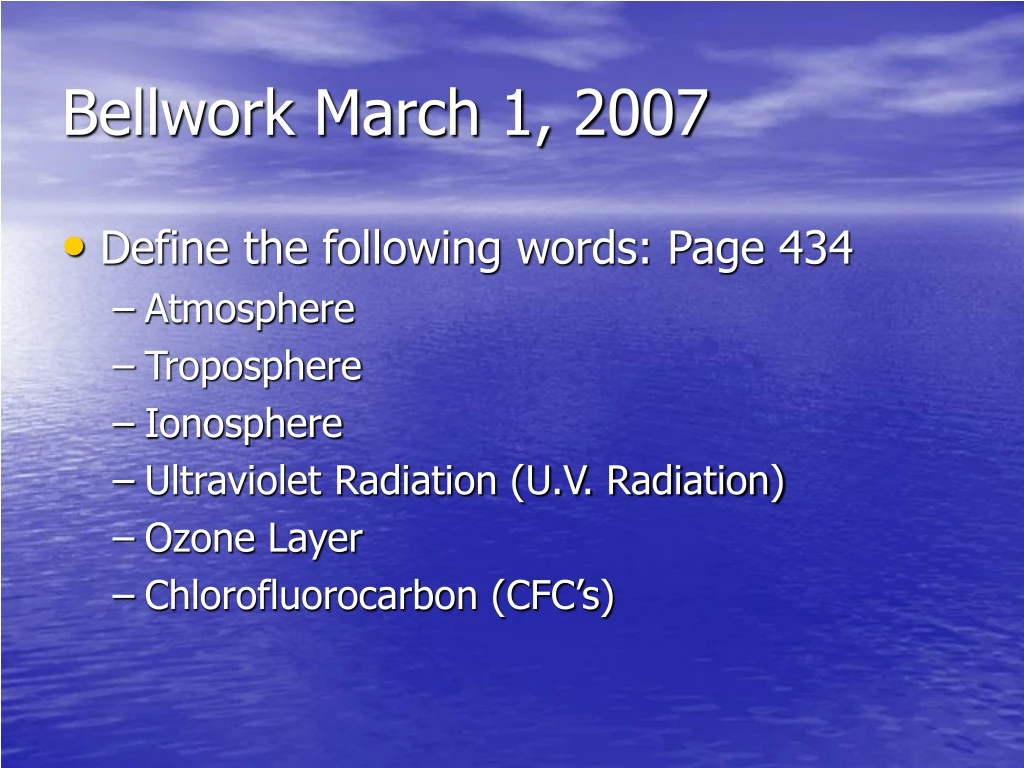
Bellwork March 1, 2007 • Define the following words: Page 434 • Atmosphere • Troposphere • Ionosphere • Ultraviolet Radiation (U.V. Radiation) • Ozone Layer • Chlorofluorocarbon (CFC’s)
What is the Atmosphere? • The atmosphere surrounds Earth and protects us by blocking out dangerous rays from the sun. • Is a mixture of gases that is layered and becomes thinner until it gradually reaches space. • Insulates the Earth.
Composition of Earth’s Atmosphere • 78% Nitrogen • 21% Oxygen • ~3% Water Vapor • 0.93% Argon • 0.04% Carbon Dioxide • trace amounts of other gases
Layers of the Atmosphere • Divided into five different and distinct layers. • Lower layers include the troposphere and stratosphere • Upper layers are the mesosphere, thermosphere and exosphere. Page 436
Lower Layers • Troposphere • Stratosphere
Troposphere • Where we study, eat, sleep, and play. • Lowest of Earth’s atmospheric layers. • Contains 99% of the water vapor and 75% of atmospheric gases. • Layer in which clouds and weather occur.
Stratosphere • ~ 10 km (6mi) to 50 km (30mi) above Earth’s Surface • Contains Ozone (O3) Layer • Temperature increases with altitude.
Upper Layers • Mesosphere • Thermosphere • Exosphere Page 437
Mesosphere • From Stratosphere to 80 km (50mi) above surface. • Temperature decreases with altitude. • Layer in which most meteors will burn up.
Ionosphere • Layer of electrically charged particles. • Contained within the mesosphere and thermosphere. • Allows radio waves to travel across the country. Pg 437
Thermosphere • Extends to from mesosphere to 500km • Contains the Auroras • Thickest of the layers • Temperature varies greatly based on solar energy. • Can heat up to 1,500°C or higher
Exosphere • Outermost layer extending to 800 km. • Where satellites and shuttles orbit the Earth. • Contains very few molecules
Ozone Layer • Contained within the stratosphere. • It helps to protect us from the sun’s rays. • Located 19-48 km above us. • Made of ozone (O3). • Destroyed by CFC’s. • Hole in the ozone layer is increasing each year. • When the ozone layer disappears there will be more cases of skin cancer. Student’s Created
Assignment • Draw the layers of the atmosphere. • Label each layer with the following: • Name • Range (distance from Earth’s Surface) • Characteristics • Temperature Range (Page 439)