Download

1 / 13
130 likes | 257 Vues
This overview highlights the formative years of the United States from 1789 to 1801, detailing the pivotal events during George Washington's presidency and the subsequent presidency of John Adams. Key developments include the establishment of three executive departments under Washington, Hamilton's financial plan, the Whiskey Rebellion, Washington's Farewell Address advocating neutrality, and the political turbulence of Adams' term including the Alien and Sedition Acts and the critical election of 1800, marking a peaceful transition of power.

E N D
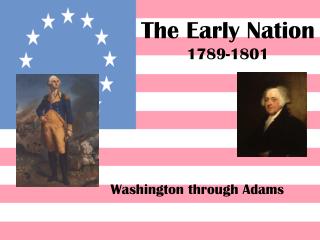
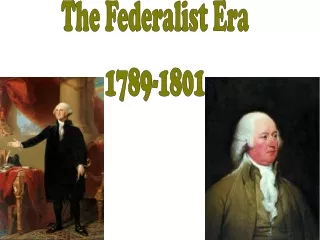
The Early Nation1789-1801 Washington through Adams
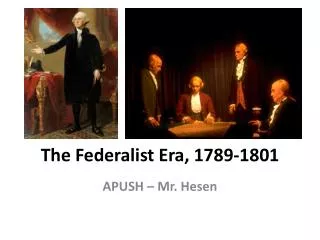
George Washington’s Presidency1789-1797 A REAL American Hero…..
Events at Home Creation of Three executive departments: • State: foreign affairs; headed by Thomas Jefferson • Treasury: money; headed by Alexander Hamilton • War: defense; -headed by Henry Knox
More Events at Home Judiciary Act of 1789 created the Supreme Court & other Federal Courts
Yes, Even More Events at Home Alexander Hamilton’s Financial Plan • created protective tariffs to promote industry • established the National Bank to provide the nation with stable currency • created an excise tax on whiskey to raise revenue
No More Events at Home, After This One Whiskey Rebellion • Farmers in western Pennsylvania refused to pay the federal excise tax on whiskey and attacked tax collectors. Washington made 15,000 militia men into federal troops and put down the rebellion. As a result, the Federal government showed its new power.
Foreign Affairs…. Neutrality Act of 1793 • The United States would not get involved in a war between the French and the British
Ok, I lied, but this is really the last event at home Washington’s Farewell Address (1797) • George Washington’s final advice to the United States was that the US should • (a) be neutral • (b) remain united • (c) avoid permanent alliances • (d) not have political parties
John Adams’s Presidency (1797 --1801) In the election of 1796, John Adams defeated Thomas Jefferson for the presidency, and Jefferson became the vice-president.
Adams had Issues • Alien and Sedition Acts (1798) • The President could imprison or deport aliens (citizens of other countries). People who wrote anything of “a scandalous and malicious nature” against the government could be imprisoned. *Used to silence critics of the Federalist party (i.e. the Democratic-Republicans) *
Adams has Issues The Virginia and Kentucky Resolves • Virginia and Kentucky declare the Alien and Sedition Acts “null” because they violated the Bill of Rights • XYZ Affair
You’re gone before we knew you…. Election of 1800 John Adams (Federalist) -v- Thomas Jefferson (Democratic-Republicans) The election of 1800, won by Jefferson, was the first presidential election in which power was peacefully transferred from one party to another.