Forces
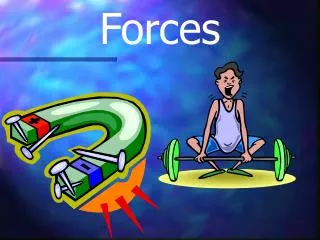
Learn about forces, free body diagrams, friction, Atwood devices, and Newton's Laws of Motion. Understand the fundamental forces of gravity and electromagnetism. Explore examples of forces and the action-reaction principle. Discover how inertia and weight affect motion. Develop problem-solving skills in force and motion in 1-D. Find out how an astronaut in space can make it back to safety after a tether snaps.

Forces
E N D
Presentation Transcript
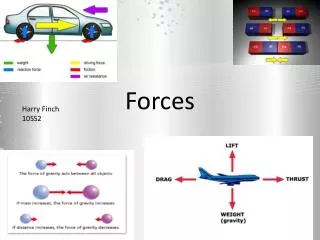
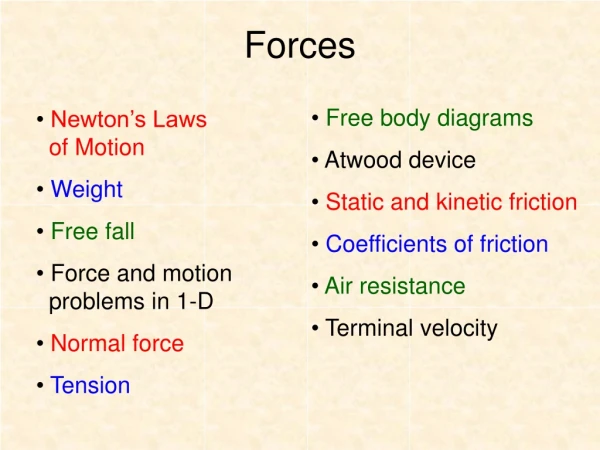
Forces • Free body diagrams • Atwood device • Static and kinetic friction • Coefficients of friction • Air resistance • Terminal velocity • Newton’s Laws of Motion • Weight • Free fall • Force and motion problems in 1-D • Normal force • Tension
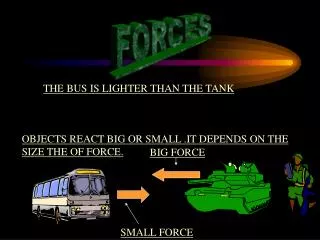
Examples of Forces • A force is just a push or pull. Examples: • an object’s weight • tension in a rope • a left hook to the schnozola • friction • attraction between an electron and proton • Bodies don’t have to be in contact to exert forces on each other, e.g., gravity.
Fundamental Forces of Nature • Gravity • Attraction between any two bodies w/ mass • Weakest but most dominant • Electromagnetic • Forces between any two bodies w/ charge • Attractive or repulsive • Weak nuclear force – responsible for radioactive decay • Strong nuclear force – holds quarks together (constituents of protons and neutrons)
Newton’s Laws of Motion • Inertia: “An object in motion tends to stay in motion. An object at rest tends to stay at rest.” • Fnet = ma • Action – Reaction: “For every action there is an equal but opposite reaction.”
1st Law: Inertia “An object in motion tends to stay in motion; an object at rest tends to stay at rest.” • A moving body will continue moving in the same direction with the same speed until some net force acts on it. • A body at rest will remain at rest unless a net force acts on it. • Summing it up: It takes a net force to change a body’s velocity.
Inertia Example 1 An astronaut in outer space will continue drifting in the same direction at the same speed indefinitely, until acted upon by an outside force.
Inertia Example 2 If you’re driving at 65 mph and have an accident, your car may come to a stop in an instant, while your body is still moving at 65 mph. Without a seatbelt, your inertia could carry you through the windshield.
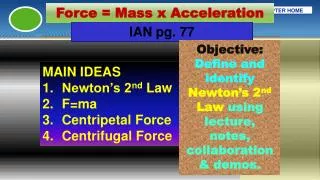
2nd Law: F= ma • The acceleration an object undergoes is directly proportion to the net force acting on it. • Mass is the constant of proportionality. • For a given mass, if F doubles, triples, etc. in size, so does a. • For a given Fif m doubles, a is cut in half. • The 1st law is really a special case of the 2nd law (if net force is zero, so is acceleration).
F a Graph of Fvs. a In the lab various known forces are applied—one at a time, to the same mass—and the corresponding accelerations are measured. The data are plotted. Since Fand aare directly proportional, the relationship is linear.
Graph of Fvs. m If the same force is applied to increasing masses, and the corresponding accelerations are measured, the plot will appear as below. Since Fand mare inversely proportional, the relationship is inverse. F m
W = mg • Weight = mass acceleration due to gravity. • This follows directly from F = ma. • Weight is the force of gravity on a body. • Near the surface of the Earth, g = 9.8 m/s2.
“For every action there’s an equal but opposite reaction.” Action - Reaction • If you hit a tennis ball with a racquet, the force on the ball due to the racquet is the same as the force on the racquet due to the ball, except in the opposite direction. • If you drop an apple, the Earth pulls on the apple just as hard as the apple pulls on the Earth. • If you fire a rifle, the bullet pushes the rifle backwards just as hard as the rifle pushes the bullet forwards.
Lost in Space Suppose an International Space Station astronaut is on a spacewalk when her tether snaps. Drifting away from the safety of the station, what might she do to make it back?