Download
1 / 21
210 likes | 336 Vues
This overview covers the essential processes of skeletal muscle contraction, detailing the neuromuscular junction, the role of actin and myosin, and the mechanisms of excitation-contraction coupling. The sliding filament theory is explained, highlighting the interaction of thin and thick filaments. Additionally, it addresses muscle relaxation, the importance of ATP, and conditions such as polio, botulism, and myasthenia gravis, along with their symptoms and treatments. This comprehensive insight into the muscular system is vital for understanding muscle function and related disorders.

E N D
The Muscular System Part II Skeletal Muscle Contraction
Introduction • Muscles receive… • Actin and myosin… • Sarcomeres… • Muscle fibers… • Pulls on…
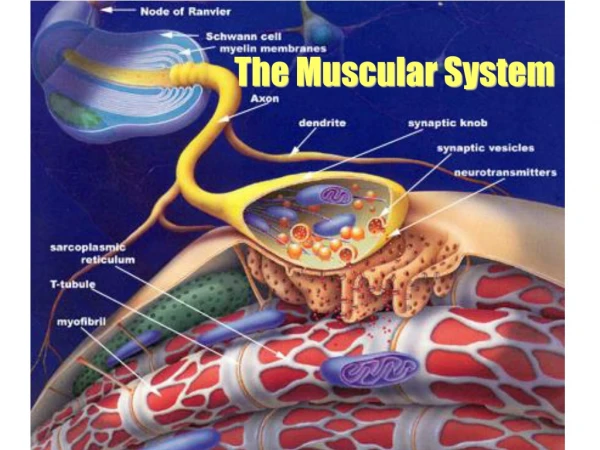
Neuromuscular Junction • Each skeletal muscle fiber ___________ connected to a neuron • Neurons (Motor Neurons) 1. 2. 3. • Neurotransmitters 1. 2. 3. 4.
Neuromuscular Junction • Synapse 1. 2. • Ach receptors 1. 2.
Stimulus for Contraction • Muscle impulse 1. 2.
Excitation Contraction Coupling • Muscle impulse causes … • Ca2+ binds to … • Binding sites … • Actin can…
The Sliding Filament Theory • Sarcomeres… • Thin and thick filaments … • Slide past one another 1. 2. 3.
Cross-Bridge Cycling • Sarcomere shortening 1. 2. 3. • ATP is required 1. 2. • Cross- bridge binding repeats 1. 2.
Relaxation • Nerve impulse… • Acetylcholinesterase 1. 2. • Calcium … • Myosin… • Tropomyosin … *ATP … • Rigor mortis
Diseases of the Muscular System • Polio 1. 2. • Botulism 1. 2.
Clin. App. 9.1: Myasthenia Gravis 1. 2. 3. Symptoms a. b. 4. Treatment a. b. c. d.