Optimal Physical Activity Levels in Children with Chronic Lung Disease: A Research Study
This study evaluates the optimal levels of physical activity in children and adolescents suffering from chronic lung disease (CLD). With a focus on parameters such as VO2max, ventilatory equivalent for oxygen (VE/VO2), and exercise-induced bronchospasm (EIB), we analyze the correlation between aerobic fitness and physical activity levels. The research includes a control group and assesses pulmonary function through spirometry and exercise stress tests. Results indicate variations in lung function among participants with different types of chronic lung conditions.

Optimal Physical Activity Levels in Children with Chronic Lung Disease: A Research Study
E N D
Presentation Transcript
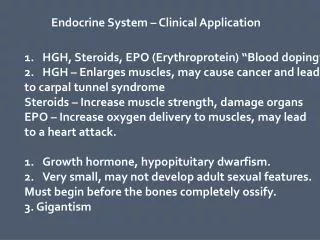
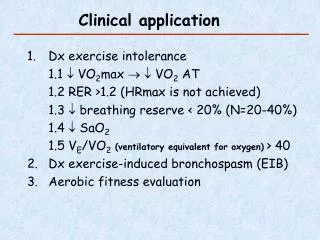
Clinical application • Dx exercise intolerance 1.1 VO2max VO2 AT 1.2 RER >1.2 (HRmax is not achieved) 1.3 breathing reserve < 20% (N=20-40%) 1.4 SaO2 1.5 VE/VO2(ventilatory equivalent for oxygen)> 40 • Dx exercise-induced bronchospasm (EIB) • Aerobic fitness evaluation
Research study Optimal level of physical activity in children and adolescent with chronic lung disease
To study the optimal level of physical activityin children and adolescents with CLD Objectives
Experimental design Normal (n=18) CLD (n=18) Hx & PE VO2 at AT correlate with physical activity PFT - Spirometry - Lung volumes - DLco Exercise stress test
Results Chronic lung diseases: - Chronic interstitial lung 1 - Post lobectomy 5 - Pulmonary hemosiderosis 1 - Fibrotic lung 3 - BPD 2 - Asthma moderate persistent 6
Abnormal PFT • Obstructive lung 7 (FEV1 80.0 + 12.9%pred) • Restrictive lung 7 (TLC 63.7 + 12.5%pred) • Diffusion defect 1 (DLco/VA = 77 %pred) • Hyperinflation 9 (RV/TLC 38.9 + 6.5%pred)