Download
1 / 21
210 likes | 380 Vues
This guide delves into the principles of Experiential Learning, highlighting the contributions of key theorists like John Dewey, Carl Rogers, and David Kolb. Learners will gain the ability to identify theorists, outline Kolb’s Experiential Learning Model, and describe each step's purpose. Additionally, this resource provides practical activities and strategies for designing lesson plans that embody experiential learning principles, enabling facilitators to engage learners effectively through reflection and active participation in their educational journeys.

E N D
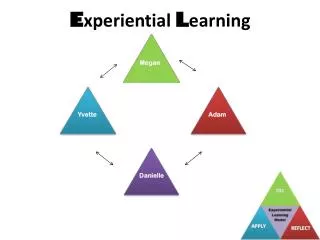
Experiential Learning Megan Yvette Adam Danielle
Performance Objectives • When prompted, the learner will be able to state the names of the three Experiential Learning theorists accurately. • Given a blank Experiential Learning Model diagram, the learner will write each of the five steps in the correct location. • Given a step in the Experiential Learning Model, the learner will be able to describe its purpose as defined in the presentation. • Given a learning objective, the learner will be able to design and implement a lesson to teach the objective following the Experiential Learning Model.
What happened? REFLECT
What’s Important? REFLECT
John Dewey “We do not learn from experience... we learn from reflecting on experience.” – John Dewey, 1933
Carl Rogers (1902-1987) “Experience is, for me, the highest authority. The touchstone of validity is my own experience. No other person's ideas, and none of my own ideas, are as authoritative as my experience.” —Carl Rogers, 1961
Facilitator Core Qualities 1. 2. 3.
Carl Rogers Video Carl Roger's view of the teacher/learner relationship
David Kolb “Learning is the process whereby knowledge is created through the transformation of experience.” –David Kolb, 1984
Learning Styles • Assimilators • Convergers • Accommodators • Divergers
“So What”Activity • Some ideas of what you could teach…. • Paper airplanes • Paper hats • Friendship bracelets • A new song(we have a silly song lyrics printed) • Draw a tree / portrait • Use the email app on a cellphone • Get creative! DO
What happened? REFLECT
References Dewey, J. (1938). Experience and education. New York: Touchstone. Gutek, G. (2005). Jacques Maritain and John Dewey on Education: A Reconsideration. Educational Horizons, 83(4), 247-263. Retrieved from http://www.eric.ed.gov/PDFS/EJ781979.pdf Jacobson, M. & Ruddy, M. (2004). Open to Outcome: A practical guide for facilitating and teaching. Bethany, OK: Wood ‘N’ Barnes Publishing. Merriam, S. B., Caffarella, R. S., & Baumgartner, L. (2007). Learning in adulthood, a comprehensive guide. (Third ed.). San Francisco: Jossey-Bass. Pfeiffer, W. & Jones, J. E. (1975). A Handbook of Structured Experiences for Human Relations Training. La Jolla, California: University Associates. Tennant, M., & Pogson, P. (1995). Learning and Change in the Adult Years. San Francisco: Jossey-Bass.