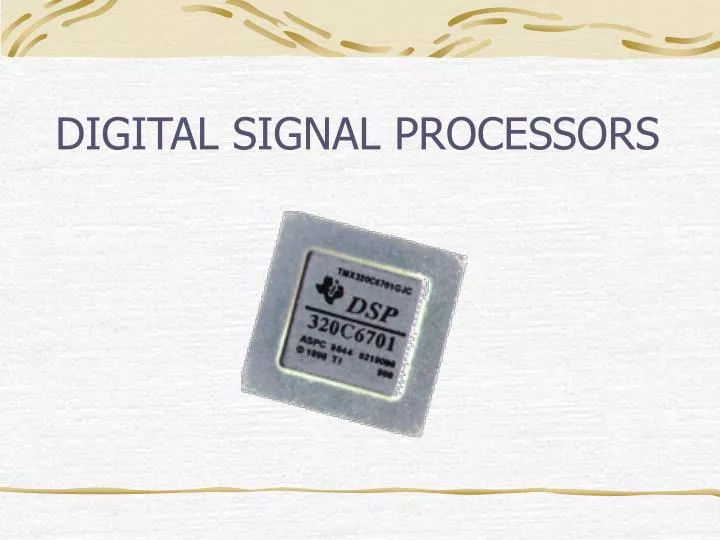

DIGITAL SIGNAL PROCESSORS
E N D
Presentation Transcript
What are Digital Signals? • Digital signals have finite precision in both the time (sampled) and amplitude (quantized) domains.
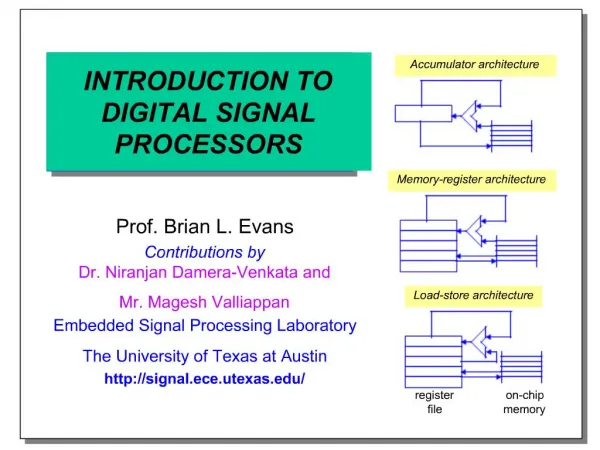
What are Digital Signal Processors? • Digital Signal Processors are microprocessors optimized to perform digital signal processing tasks.
Uses of DSPs • Telephone: Signal Multiplexing • Military: RADAR • Medicine: MRI • Scientific: Spectral Analysis • Industrial: Oil Prospecting • Commercial: Movie Special Effects
Characteristics of DSPs • Real-time processing • Limited data types (e.g. floating point) • Very Large Instruction Word (VLIW) architecture
Characteristics (contd…) • DSPs are optimized for mathematical calculations (as opposed to data manipulation).
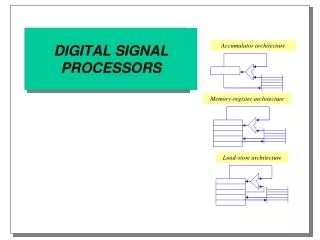
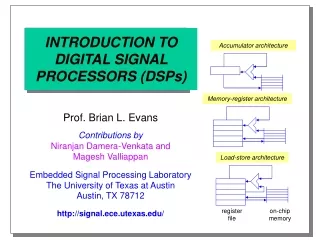
Characteristics (contd…) • Harvard Architecture
Characteristics (contd…) • Specialized registers (e.g. extended precision accumulators) • Onboard fast RAM, ROM, DMA • Massive Parallelism
Floating Point vs. Fixed Point • Advantages of Floating Point: • Precision • Greater Dynamic Range • Shorter Development Time • Better Signal-to-noise Ratio • Disadvantages of Floating Point: • Expensive
Assembly vs. C • Advantages of Assembly • Faster • Requires less memory • Disadvantages of Assembly • Expensive • Hard to maintain • Intimate knowledge of hardware required
Sample DSP: SMJ320C6701 • Military DSP used in munitions guidance, avionics, navigation, electronic countermeasures, anti-submarine warfare, etc.
SMJ320C6701 (contd…) • Up to 1 GFLOPS at 167 MHz • Load/Store architecture • Instructions operate on data in registers
SMJ320C6701 (contd…) • VLIW architecture • IEEE floating point • Double precision 4 cycle throughput • Single precision 1 cycle throughput • Variable length execution packets
SMJ320C6701 (contd…) • CPU
SMJ320C6701 (contd…) • Internal Program Memory • Internal Data Memory • Host Port Interface • Allows other processors access to internal DSP memory.
SMJ320C6701 (contd…) • Multichannel Buffered Serial Port • Allows fast inter-processor communication • Direct Memory Access • Fewer CPU interrupts • External Memory Interface • Glueless interface to SBRAM, SRDRAM and SRAM
Some Signals • CLOCK • CLKIN: clock input • CLKMODE: x4 or x1 output clock f • DMA • DMAC3,2,1,0: DMA action complete • EMIF control • CE3,2,1,0: memory space enables, enabled by bits 24 and 25 of word address
Some Signals (contd…) • Bus Arbitration • HOLD: HOLD request • HOLDA: HOLD acknowledge • DRAM control • SDRAS: SDRAM row address strobe • SDCAS: SDRAM column strobe • SDWE: SDRAM write enable • SDCLK: SDRAM clock