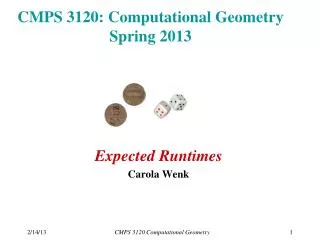
Computational Geometry: Probability and Expected Runtimes
60 likes | 159 Vues
Learn about probability distributions, random variables, expected values, and randomized algorithms in computational geometry. Understand Laplacian probability and Linearity of Expectation. Examples include dice rolls and game outcomes.


Computational Geometry: Probability and Expected Runtimes
E N D
Presentation Transcript
CMPS 3120: Computational GeometrySpring 2013 Expected Runtimes Carola Wenk CMPS 3120 Computational Geometry
Probability • Let S be a sample space of possible outcomes. • ES is an event • The (Laplacian) probability of E is defined as P(E)=|E|/|S| P(s)=1/|S| for all sS Note: This is a special case of a probability distribution. In general P(s) can be quite arbitrary. For a loaded die the probabilities could be for example P(6)=1/2 and P(1)=P(2)=P(3)=P(4)=P(5)=1/10. • Example: Rolling a (six-sided) die • S = {1,2,3,4,5,6} • P(2) = P({2}) = 1/|S| = 1/6 • Let E ={2,6}P(E) = 2/6 = 1/3 = P(rolling a 2 or a 6) • In general: For any sS and any ES • 0 P(s) 1 • P(s) = 1 • P(E) = P(s) sS sE CMPS 3120 Computational Geometry
Random Variable Head • A random variable X on S is a function from S to RX: S→ R Tail Head • Example 1: Flip coin three times. • S = {HHH, HHT, HTH, HTT, THH, THT, TTH, TTT} • Let X(s) = # heads ins X(HHH) = 3X(HHT)=X(HTH)=X(THH) = 2X(TTH)=X(THT)=X(HTH) = 1X(TTT) = 0 • Example 2: Play game: Win $5 when getting HHH, pay $1 otherwise • Let Y(s) be the win/loss for the outcomes • Y(HHH) = 5Y(HHT) = Y(HTH) = … = -1 What is the average win/loss? CMPS 3120 Computational Geometry
Expected Value Notice the similarity to the arithmetic mean (or average). sS xR • The expected value of a random variable X: S→Ris defined asE(X) = P(s) X(s) = P({X=x}) x • Example 2 (continued): • E(Y) = P(s) Y(s) = P(HHH) 5 + P(s) (-1) = 1/23 5 + 7 1/23 (-1) • = (5-7)/23 = -2/8 = -1/4 • = P({Y=y}) y = P(HHH)5 + P(HHT) (-1) + P(HTH) (-1) + P(HTT) • (-1) + P(THH) (-1) + P(THT) (-1) + P(TTH) (-1) + P(TTT) (-1) • The average win/loss is E(Y) = -1/4 sS sS\{HHH} xR Theorem (Linearity of Expectation): Let X,Ybe two random variables onS. Then the following holds:E(X+Y) = E(X) + E(Y) Proof: E(X+Y) = P(s) (X(s)+Y(s)) = P(s)X(s) + P(s)Y(s) = E(X) + E(Y) sS sS sS CMPS 3120 Computational Geometry
Randomized algorithms • Allow random choices during the algorithm • Sample space S = {all sequences of random choices} • The runtime T: S→Ris a random variable. The runtime T(s) depends on the particular sequence s of random choices. Consider the expected runtimeE(T) • Example 3 (Quicksort): • Pick a random pivot to partition the array around. • Runtime depends on random pivot choices. • Best case: ½ : ½ split in each step. (In fact, 1/10 : 9/10 would work as well.) O(n log n) runtime • Worst case: 0 : (n-1) split O(n2) runtime • Expected runtime E(T) “averages” over all possible splits, and one can show that E(T) = O(n log n) CMPS 3120 Computational Geometry
Randomized algorithms • Example 4 (Trapezoidal map): • The runtime depends on the order in which trapezoids are inserted: • ki = # new trapezoids created; total runtime is i=1 ki • Worst case:ki=O(i)Total worst-case runtime isi=1i= O(n2) • Best case:ki=O(1)Total best-case runtime isi=1 1= O(n) • Insert segments in random order: • P = {all possible permutations/orders of segments}; |P| = n! for n segments • ki = ki(p) for some random order pP • E(ki)=O(1)(see theorem on slides) • Expected runtimeE(T) = E(i=1ki)=i=1E(ki)= O(i=11)= O(n) n n n n n n linearity of expectation CMPS 3120 Computational Geometry