
SlideServe
Menu
Préférences
© SlideServe · v2026

Water Potential Problems

brady-miller avatar
17 diapositives · 428 Views · Oct 31, 2014

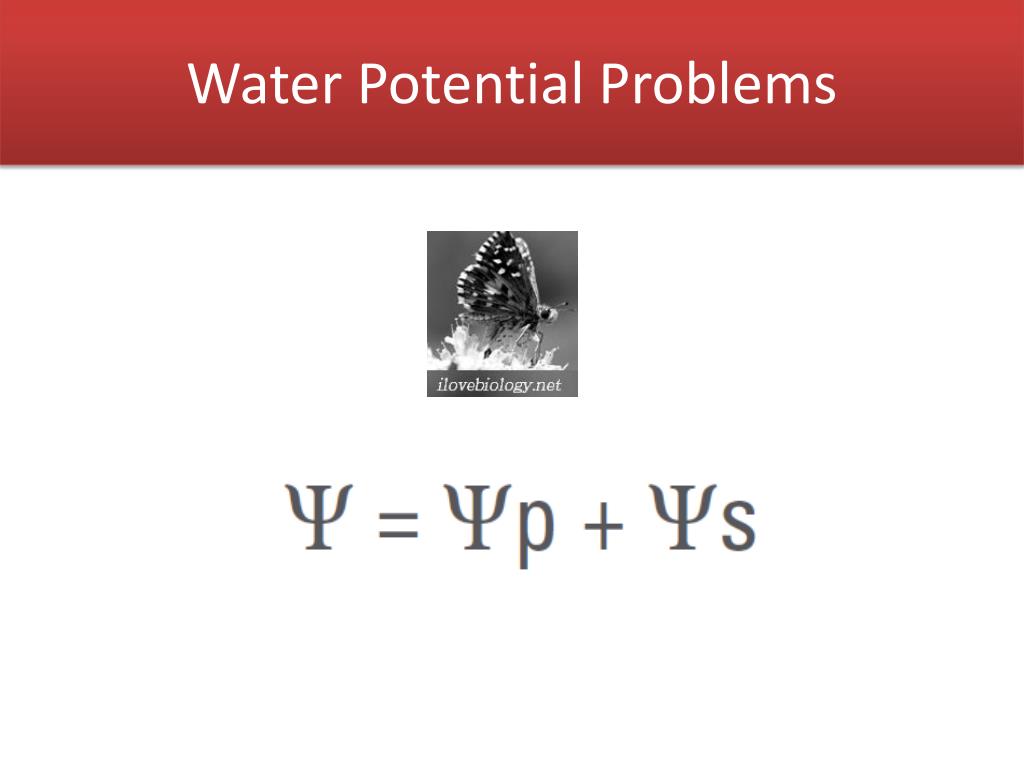
Water Potential Problems. Water Potential ( ). Water potential of pure water in an open container is 0. =  p +  s Water PRESSURE SOLUTE Potential Potential Potential. = 0 + 0
Water Potential Problems - slide 1
01 / 17Water Potential Problems
1 / 17

Télécharger la présentation

Water Potential Problems
Une image / un lien ci-dessous est fourni (tel quel) pour télécharger la présentation

Politique de téléchargement : le contenu du site vous est fourni TEL QUEL pour votre information et votre usage personnel ; il ne peut être vendu, concédé sous licence ni partagé sur d’autres sites sans l’accord de son auteur.Le contenu vous est fourni TEL QUEL, pour votre information et votre usage personnel uniquement. Téléchargez la présentation en cliquant sur ce lien. Lors du téléchargement, si vous ne parvenez pas à télécharger une présentation, l’éditeur a peut-être supprimé le fichier de son serveur.Pendant le téléchargement, si vous ne parvenez pas à obtenir une présentation, le fichier a peut-être été supprimé par l’éditeur.

F I N

Plus de contenu associé

Transcription de la présentation
  1. Water Potential Problems

  2. Water Potential ()

  3. Water potential of pure water in an open container is 0. • = p + s • Water PRESSURE SOLUTE • Potential PotentialPotential • = 0 + 0 • Water PRESSURE SOLUTE • Potential PotentialPotential

  4. Water will flow from an area of higher water potential to an area of lower water potential.  

  5. Question: Which way will the water flow? Into the cell or out of the cell? Answer: Water will flow into the cell. Explanation: Water will continue to flow in both directions. However, more water will be entering the cell. So the NET MOVEMENT of water will be INTO the cell. Water will flow from an area of higher water potential to an area of lower water potential (from  = -0.5 to  = -2.5). This will continue until dynamic equilibrium is reached.  = -2.5  = -0.5

  6. Addition of solutes = a more negative solute potential. S < 0

  7. In an open container or in an animal cell, the pressure potential will be 0. P = 0

  8. In turgid plant cells, the cell wall can exert positive pressure. P > 0

  9. Solute Potential (S)

  10. i = ionization constant • For sucrose, i = 1 because sucrose does not ionize in water. • For NaCl,i = 2 because NaCl ionizes when it dissolves and becomes one Na+ and one Cl- ion in an aqueous solution. 1 ion + 1 ion = 2 ions

  11. Question: For MgCl2, what would i be? Answer: i = 3 Explanation: Mg would ionize into 3 ions if dissolved in water: one Mg2+ ion and two Cl- ions.

  12. C is the molar concentration of the solution. Moles Solute Volume of Solution moles L Molarity = M =

  13. R is the pressure constant. • Always will be 0.0831 L bars / mole K

  14. T = temperature in Kelvin • Kelvin is the temperature in degrees Celsius + 273. Question: Room temperature is about 20°C. What would this be in Kelvin? Answer: 20 + 273 = 293K

  15. Example: If a cell’s P = 3 bars and S = -4.5 bars, what is the resulting ? = P + S Answer: • = 3 bars + (-4.5 bars) • = -1.5 bars

  16. Question: A cell with a  = -1.5 bars is placed in a beaker with a solution of  = -4 bars. Will water flow into or out of the cell? Answer: Water will flow out of the cell from an area of higher water potential (-1.5 bars) to an area of lower water potential (-4 bars).

  17. Question: What is the  of a 0.1 M solution of sucrose in at open container at 20°C? • = P + S S = -iCRT • Answer: -2.4 bars • Explanation: S = -iCRT • S = -(1)(0.1 )(0.0831 )(293K) • S = -2.4 bars • = P + S • = 0 + (-2.4 bars) = -2.4 bars mole L L bar mole· K  = ?