Download
1 / 21
210 likes | 326 Vues
Explore the development of Muslim identity within families, schools, and communities. Learn about the differences and consequences of identity, the challenges of maintaining identity in America, and the intricate details of Sunni and Shia beliefs. Discover statistics, similarities, and dissimilarities between Sunni and Shia schools of thought, and the importance of cultural and nationalistic identities in a diverse society. Seize the unique opportunities in America while staying true to your heritage and faith.

E N D
IDENTITY-SUNNI VERSION Muslim Majority
Development of Identity • Within a few months of birth • Grows in family • Grows further in school and community • Sees differences in: • Color • Language • Religion • Behavior and Customs
Consequences of Identity • When Affirmative Can be an Incentive: • to flourish and • innovate • When Negative Can: • Lower self-respect and • even destroy self-confidence
Identity in America • Born in America and raised by immigrant parents • Middle Eastern • Irish • Chinese • Buddhist, Hindu, Jewish, or other identities • Immigrated to America, thus facing: • Cultural clashes • Nationality dilemma • Language barrier • Education seeking
Hold to Identity • Islamicly: • Sunni • Shi’a • Culturally: • Habits, ethics, and Morality • Nationality: • Language • Education
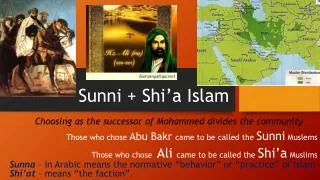
Two Branches of Islam The Shi’a and The Sunni
Islamic Identity • Know your Islamic Affiliation: Shi’a or Sunni • Educate yourself about your conviction • Master the English to express yourself well • Express yourself with conviction and vigor • Talk with confidence and with pride
Sunni Schools of Thought: • At first there were many Schools of Thought (more than 20 schools). • Through time only four schools persisted: • Hanafi • Maaliki • Shafi‘i • Hanbali
Statistics as of 1996: SHI’A …………………………………………..…….. 282 Millions SUNNI • Hanafi …………….……………………...…………. 380 Millions • Maaliki ………………………………………………. 305 Millions • Shafi’i ……………………………………………….. 190 Millions • Hanbali …………………………………….......…….. 52 Millions
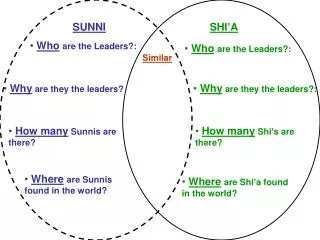
Similarities: Sunni-Shi’a • Faith • Doctrine • Basics of Rituals • Ethical Values • Eschatology
Dissimilarities: Sunni-Shi’a • Political: Matter of the Khilaafah • Ahlul Bayt (Family of the Prophet) • Expression of Rituals: the Ritual Technique • Evolution of Heritage: Shi’a versus Sunni • Source References • Tafseer, • Hadith, • Other Islamic interpretation
The Sunni and Ahlul Bayt • 300 narrators of all Al-Sihah Al-Sitta were students of Al-Saadiq • 70 narrators of Al-Bukhari were students of Al-Saadiq • Ahlul Bayt Carried out the Teaching of Islam after the Prophet for 329 Years over Twelve Generations • The best available means to teach in absence of media
Sunni Heritage • Identify with One of 4 Madh’habs: • Hanafi and its Fiqh • Shafi’i and its Fiqh • Maaliki and its Fiqh • Hanbali and its Fiqh • Identify exclusively with Al-Sihaah Al-Sitta
Cultural Identity • Hold to your ways but be discerning • Make effort to befriend people of your nationality • Be friendly to Americans • Explain to Americans your ways with pride • Make Frequent visits to Islamic Centers
Nationalistic Identity • Speak your language with parents • Teach children Arabic as well as your own language • Celebrate your usual national holidays • Attend meetings catering to your national aspirations
Unique opportunity in America • The US is your host country that gives you freedom of expression and work opportunity • As its guest: • respect the ways fit for the Americans, but • keep your ways intact and sound • Be innovative and aggressive in pursuit of you goals and aims
Unique opportunity in America • Get involved in the American Process • Seek Professions: • Business • Construction • Government • Political • Administrative • Investments • The Myriad others available • Encourage your children to Pursue Professions of Potential Value to America as well as Islamic Society
THANK YOU Be in Allah’s Care A.S. Hashim, MD