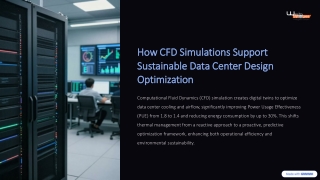
How CFD Simulations Support Sustainable Data Center Design Optimization
0 likes | 0 Vues
This presentation highlights how CFD simulations significantly enhance data center sustainability by optimizing airflow, improving cooling efficiency, preventing hotspots, and reducing overall energy consumption. It details how CFDu2014integrated with digital twins and AIu2014enables predictive maintenance, boosts PUE, reduces carbon footprint, strengthens ESG and green building compliance, and supports smarter, more resilient, and future-ready data center operations.


How CFD Simulations Support Sustainable Data Center Design Optimization
E N D
Presentation Transcript
How CFD Simulations Support How CFD Simulations Support Sustainable Data Center Design Sustainable Data Center Design Optimization Optimization Computational Fluid Dynamics (CFD) simulation creates digital twins to optimize data center cooling and airflow, significantly improving Power Usage Effectiveness (PUE) from 1.8 to 1.4 and reducing energy consumption by up to 30%. This shifts thermal management from a reactive approach to a proactive, predictive optimization framework, enhancing both operational efficiency and environmental sustainability. preencoded.png
Why Sustainable Data Centers Need CFD Simulations 1% Modern data centers Modern data centers are denser, more powerful, and far more heat-intensive than ever before. As compute workloads increase exponentially, managing airflow, Global Electricity temperature distribution, and energy efficiency becomes increasingly complex. Data center share rising with digital workloads 30% Traditional cooling approaches based on rules of thumb and oversizing can no longer meet the demands of high-density deployments. CFD numerically models fluid and air behavior using fundamental principles of Efficiency Gain thermodynamics, fluid mechanics, and heat transfer. This computational approach CFD-guided retrofits achieve 40% enables evidence-based, physics-driven decisions rather than assumptions. Sustainability goes beyond simply adding renewable energy—it's about maximizing useful work per watt, where CFD delivers quantifiable value through precise thermal management. Cooling Energy Portion of site energy consumption preencoded.png
Energy Challenges in Data Centers Energy Challenges in Data Centers Cooling Energy Consumption Cooling Energy Consumption Airflow and Heat Control Airflow and Heat Control Thermal Inefficiency Thermal Inefficiency Cooling systems can consume up to 40% of Poor airflow creates hotspots that reduce Temperature imbalances drive inefficiency total site energy. CFD helps test cooling hardware lifespan and strain cooling systems. through overcooling or localized overheating. configurations virtually to identify the most CFD predicts airflow patterns to optimize rack CFD reveals where energy is wasted, enabling sustainable and cost-effective approaches layouts, containment strategies, and cooling targeted improvements that deliver maximum before physical implementation. for consistent, reliable performance. return on investment. preencoded.png
Understanding CFD Simulations in Data Center Design Understanding CFD Simulations in Data Center Design Virtual Twin Creation Virtual Twin Creation Airflow Visualization Airflow Visualization Engineers build a computational model representing the physical facility, CFD solves governing equations to simulate airflow patterns, exposing including racks, cooling units, obstructions, and boundary conditions. This turbulence, recirculation zones, and hot-cold air mixing. Engineers can digital replica captures geometry, heat loads, and airflow paths with high visualize velocity vectors, temperature distributions, and pressure gradients fidelity. throughout the space. Thermal Prediction Thermal Prediction Layout Optimization Layout Optimization The simulation predicts temperature patterns across racks and aisles, Virtual layout comparisons reveal configurations that maximize cooling per identifying potential hotspots and under-cooled zones. This insight enables kilowatt, balancing scientific accuracy with scalability and real-world proactive design adjustments that improve thermal uniformity and constraints like cable routing and maintenance access. reliability. preencoded.png
How CFD Identifies Thermal Issues How CFD Identifies Thermal Issues Visualizing Airflow and Heat Behavior Visualizing Airflow and Heat Behavior CFD simulations transform abstract thermal challenges into visual, actionable intelligence. Engineers can observe airflow paths, identify recirculation zones where hot exhaust mixes with cool supply air, and detect stagnant areas where heat accumulates. The technology exposes the physics behind temperature imbalances—whether caused by poor rack arrangement, inadequate containment, blocked airflow paths, or mismatched cooling capacity. This visualization replaces guesswork with precision planning, enabling engineers to test multiple scenarios before implementing physical changes. preencoded.png
Keyways Keyways CFD Simulations Optimize Sustainable Design CFD Simulations Optimize Sustainable Design Cooling and airflow management are no longer purely operational topics—they're central to sustainability strategy. CFD turns operational data into actionable intelligence, pinpointing exactly where energy is wasted and where design changes deliver the greatest impact. Reducing Cooling Energy Reducing Cooling Energy Preventing Hotspots Early Preventing Hotspots Early Improving Power Usage Improving Power Usage Effectiveness Effectiveness CFD quantifies the impact of fan speeds, CFD identifies potential hotspots and heat By exposing airflow and cooling vent placement, temperature setpoints, recirculation paths before equipment is inefficiencies, CFD enables shifting more and containment strategies. Facilities can installed. Proactive layout and control power to compute rather than cooling meet thermal SLAs with less power and adjustments reduce hardware failures, infrastructure. This directly improves PUE lower carbon intensity by optimizing downtime, and emergency maintenance and overall sustainability performance these parameters. costs. metrics. preencoded.png
Compliance and ESG Reporting Benefits Compliance and ESG Reporting Benefits LEED Certification LEED Certification ISO 50001 Compliance ISO 50001 Compliance Singapore Green Mark Singapore Green Mark CFD delivers quantifiable evidence of energy efficiency improvements for Leadership in Energy and Environmental Design credits. Simulation results demonstrate reduced HVAC loads and optimized thermal management. The international energy management standard requires systematic identification of energy-saving opportunities. CFD provides the analytical foundation for continuous improvement programs and measurable efficiency gains. Asia's leading green building rating system recognizes CFD-based thermal modeling as evidence of sustainable design practices. Results strengthen certification applications and demonstrate commitment to low- carbon operations. CFD insights support comprehensive ESG reporting by providing verifiable data on energy consumption, carbon emissions reductions, and resource efficiency. This quantifiable evidence strengthens stakeholder confidence and aligns with growing regulatory requirements for climate-related disclosures. preencoded.png
AI-Assisted Predictive Maintenance The Future of Adaptive Cooling The Future of Adaptive Cooling Data centers are evolving into adaptive ecosystems driven by automation, AI, and sustainability objectives. CFD is the analytical backbone enabling this transformation—providing the physics-based predictions that feed intelligent control systems. Thermal and airflow outputs from CFD simulations train machine learning models that anticipate inefficiencies, detect anomalies, and trigger early interventions. This integration reduces unplanned downtime, extends asset life, and optimizes energy use in real-time. preencoded.png
Environmental and Operational Impact Environmental and Operational Impact 30% $1M+ 25% Energy Reduction Energy Reduction Cost Savings Cost Savings Emissions Cut Emissions Cut Achievable cooling efficiency improvement with CFD-guided retrofits Annual operational savings for large facilities through optimized cooling Reduction in Scope 2 carbon emissions from decreased energy consumption CFD allows comprehensive testing of energy scenarios across fans, chillers, CRAC/CRAH units, and economizers. Engineers can identify configurations that reduce consumption, lower Scope-2 emissions, and support corporate ESG targets. The technology enables progress toward UN Sustainable Development Goal 7 (Affordable and Clean Energy) and the EU Green Deal by quantifying reductions in energy use and associated emissions. Lower operational costs stem from reduced energy consumption, extended equipment lifespan through proper thermal management, and decreased maintenance expenses. Facilities achieve measurable sustainability outcomes while improving total cost of ownership—a compelling business case beyond environmental responsibility. preencoded.png
Why Partner with Web Synergies? Why Partner with Web Synergies? As data centers become the nervous system of the digital economy, organizations benefit from partners who blend engineering rigor with digital intelligence. Web Synergies integrates CFD simulation, digital twin practices, and advanced analytics to help predict performance, improve efficiency, and achieve measurable sustainability outcomes. Engineering Excellence Engineering Excellence Digital Twin Integration Digital Twin Integration Sustainability Focus Sustainability Focus Deep expertise in thermodynamics, fluid mechanics, and data center operations Live facility models that continuously optimize performance ESG-aligned solutions that reduce carbon footprint and energy costs Building smarter facilities requires vision, precision, and partnership—turning insight into innovation and sustainability into competitive advantage. Web Synergies delivers the analytical tools and implementation expertise to transform data centers from energy-intensive infrastructure into efficient, future-ready operations that support both business growth and environmental responsibility. Important Considerations: Important Considerations: CFD results should be validated against temperature and airflow measurements where possible. Results depend on input assumptions and equipment data quality. CFD is a decision-support tool, not a replacement for engineering judgment and operational expertise. preencoded.png
Thank You! Please like share and subscribe. A white x on a black background https://www.linkedin.com/company/web-synergies https://www.instagram.com/websynergies/ Description automatically generated A red and white logo Description automatically generated preencoded.png