Download
1 / 11
110 likes | 241 Vues
This comprehensive overview explores gas exchange in the alveoli, emphasizing the natural diffusion of gases driven by differences in partial pressure. It delves into the relationship between homeostasis and diffusion, discussing the respiratory center's role in controlling breathing rates. Key factors such as the impact of carbon dioxide levels on respiration, the effects of diseases like emphysema, and the body's responses to changes in blood chemistry are also examined. This information is vital for understanding respiratory function and health maintenance.

E N D
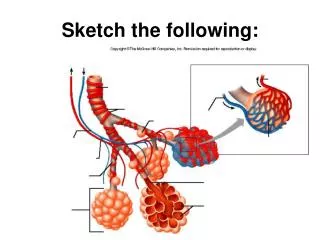
Gas Exchange Occurs in the alveoli Alveoli are COVERED in capillaries. Gases naturally move from areas of _____________ to areas of _____________. This process is a form of _______________. What is homeostasis? How does homeostasis influence diffusion? Gas exchange is driven by the maintenance of homeostasis.
Respiratory Video Clip http://player.discoveryeducation.com/index.cfm?guidAssetId=1767DD09-D896-4EF5-B406-A6824585526B&blnFromSearch=1&productcode=US#
Read about emphysema on p.444 What are 3 effects on the lungs of emphysema? How would these 3 effects compromise a person’s ability to breathe? What is the number 1 way to prevent emphysema?
Control of Breathing • The respiratory center is a group of neurons in the brain stem. • It affects respiratory rate and depth. • What is the purpose in expiration? Why do we need to exhale? • What chemical triggers would result in a faster respiratory rate? • Increased levels of CO2 or H+
Control of Breathing, continued….. Increased levels of H+: Means what? 70% of CO2 in your blood combines to form carbonic acid, which then dissociates into H+ and HCO3+. So what will happen if you don’t exhale enough CO2, and it remains in your blood longer? What chemical triggers would slow the respiratory rate back down?
Control of Breathing, continued….. What chemical changes would occur in your blood if you held your breath? What body responses would that trigger? What is hyperventilation? What changes occur in your blood if you hyperventilate? What would be the body’s response? WARNING: NOT for use when swimming!!!
Alveolar Gas Exchange • Composition of air, by both volume and partial pressure: • 78% nitrogen • 21% oxygen • 0.4% carbon dioxide • Gases diffuse from areas of higher partial pressure to areas of lower partial pressure.
Gas Transport • Oxygen transport: • Almost all oxygen (98%) is transported in combination with hemoglobin. The rest is dissolved in plasma. • The bonds between oxygen and hemoglobin are easily made and easily broken. • More oxygen is released from the hemoglobin as CO2 levels increase, blood becomes more acidic, or as blood temperature increases. • Hypoxia: ???? • Hypoxemia: ????
Gas Transport, continued….. • Carbon dioxide transport: • Transported in blood in 3 forms: • Dissolved in plasma (7%) • Bonded to hemoglobin (23%) • As part of a bicarbonate ion (70%)