Download
1 / 35
350 likes | 471 Vues
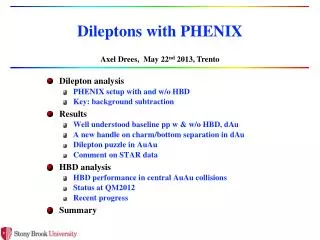
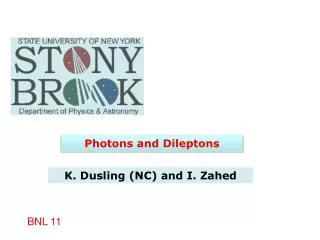
This presentation by K. Dusling and I. Zahed outlines advances in understanding photon and dilepton production rates in heavy-ion collisions, emphasizing the role of acceptance evolution and hadronic rates. The talk covers critical elements including resonance gases, chiral restoration, and the evolution of emitted particles in a quark-gluon plasma (QGP). Highlighting experimental comparisons between NA60 and PHENIX, it discusses the implications of thermal and chemical freeze-out processes on the observable signatures within the QGP context.

E N D
Photons and Dileptons K. Dusling (NC) and I. Zahed BNL 11
Outline • Set up • Rates • Evolution • Experiments
AACartoon time
Formally acceptance evolution rate
Rate l+ l+ l- l- π π π π N N
Resonance Gas: 0 ie J=ρ,ρ’,ρ’’,.. +2+3, …-Pi, +2+3, …-K +2+3, …-N Hadronic Expansion
+ … + … Many Feyman Graphs: + … +
Chiral Ward Identities: κ κ Chiral Limit and zero-mtm pion:
VA Mixing=LxR Restoration? ~κ Dey, Eletsky, Ioffe 96
Expansion Parameter: LXR = 0 “Dilute”
Input: e+e- Decay .
VA Mixing in T=180 MeV
a1a1 Typical Mixing in T=150 MeVμb=225 MeV
wQGP: l+ l+ l- l-
wQGP: γ Collinear Enhancement+ LPM Effect : Arnold, Moore, Yaffe 01
Thermal Freeze-out Cooper-Frye
Chemical Freezeout: Fireball cools faster x Rates higher = w/μπ !
PHENIX: Dusling+Z 07 Dusling+Z 09
STAR: 11’ PHENIX PRC 81 (2010) 034911 Enhancement factor in 0.15<Mee<0.75 Gev/c2 Note: Acceptance difference etc. 28
WA98: γ 0<qT (GeV) <4 0<qT (GeV)<0.8 N:x2
Rates at RHIC: γ RHIC1 RHIC2
PHENIX: γ RHIC1 RHIC2
PHENIX extrapolation: γ PHENIX: M<<qv 1
Systematics of the Extrapolation 15% Systematics!
LHC: γ 0<qT(GeV)<2 1<qT (GeV)<5
Achievements • EM “OK”* • LxR “restored” • QGP “visible” (*PHENIX)