Download

1 / 20
200 likes | 315 Vues
Significant figures are critical in physics because they convey the precision of measurements. There are two types of numbers: exact numbers, which are known with certainty (like money in an account), and approximate numbers, which are measured (like weight or height). When recording measurements, only dependable digits are noted. The rules for counting significant figures include recognizing all digits starting with the first non-zero digit, exceptions for trailing zeros, and special situations with zeros in decimal values. This guide covers the essentials of significant figures in calculations.

E N D
Significant Figures Physics
What is a significant figure? • There are 2 kinds of numbers: • Exact: the amount of money in your account. Known with certainty.
What is a significant figure? • Approximate: weight, height—anything MEASURED. No measurement is perfect.
When to use Significant figures • When a measurement is recorded only those digits that are dependable are written down.
When to use Significant figures • If you measured the width of a paper with your ruler you might record 21.7cm. To a mathematician 21.70, or 21.700 is the same.
But, to a scientist 21.7cm and 21.70cm is NOT the same • 21.700cm to a scientist means the measurement is accurate to within one thousandth of a cm.
But, to a scientist 21.7cm and 21.70cm is NOT the same • If you used an ordinary ruler, the smallest marking is the mm, so your measurement has to be recorded as 21.7cm.
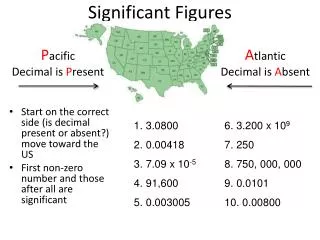
How do I know how many Sig Figs? • Rule: All digits are significant starting with the first non-zero digit on the left.
How do I know how many Sig Figs? • Exception to rule: In whole numbers that end in zero, the zeros at the end are not significant.
7 40 0.5 0.00003 7 x 10⁵ 7,000,000 1 1 1 1 1 1 How many sig figs?
How do I know how many Sig Figs? • 2nd Exception to rule: If zeros are sandwiched between non-zero digits, the zeros become significant.
How do I know how many Sig Figs? • 3rd Exception to rule: If zeros are at the end of a number that has a decimal, the zeros are significant.
How do I know how many Sig Figs? • 3rd Exception to rule: These zeros are showing how accurate the measurement or calculation are.
1.2 2100 56.76 4.00 0.0792 7,083,000,000 2 2 4 3 3 4 How many sig figs here?
3401 2100 2100.0 5.00 0.00412 8,000,050,000 4 2 5 3 3 6 How many sig figs here?
What about calculations with sig figs? • Rule: When adding or subtracting measured numbers, the answer can have no more places after the decimal than the LEAST of the measured numbers.
Add/Subtract examples • 2.45cm + 1.2cm = 3.65cm, • Round off to = 3.7cm • 7.432cm + 2cm = 9.432 round to 9cm
Multiplication and Division • Rule: When multiplying or dividing, the result can have no more significant figures than the least reliable measurement.
A couple of examples • 56.78 cm x 2.45cm = 139.111 cm2 • Round to 139cm2 • 75.8cm x 9.6cm = ?
The End Have Fun Measuring and Happy Calculating!