Download
1 / 17
170 likes | 272 Vues
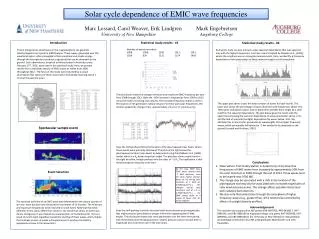
This study by Hiromoto Shibahashi from the University of Tokyo examines the long-term frequency variation in solar p-mode frequencies, highlighting the dependency on mode frequency and weak l-dependence. The research explores sudden drops near the acoustic cut-off frequency and conducts high-degree l mode analyses. The wave equation and quantization conditions are discussed, offering insights into the determination of frequency variations based on source layers and critical frequencies.

E N D
Solar cycle variationof p-mode frequencies Hiromoto Shibahashi (University of Tokyo) The First Far Eastern Workshop on Helioseismology March 15-17, 2003 Korea Institute for Advanced Study
Long-term frequency variation • Dependent on mode frequency • Very weak l-dependence • Sudden drop near the acoustic cut-off frequency • High degree l mode analyses
Long-term frequency variation High degree l p-modes crit
crit [l(l+1)]1/2c/r c(r) rsource
Basic idea • Variation in c(r) () • Variation in c(r) (/l) • Variation of source layer () for >crit
Summary • Variation of acoustic potential • Frequency dependence part • Frequency / Degree dependence part • Variation of source layer • Variation in HIP frequency • Magnetic variation • Irradiance variation