
The Constitution
E N D
Presentation Transcript
The Constitution Paula Childs
Vocabulary: • Opinion • Legislation • Living Document • Repealed • Overturned
Preamble • The introduction to the Constitution is called the Preamble. • The Preamble begins with the phrase “We the people…” • What does that mean? • Why was the Constitution written? • Who does the Constitution regulate?
Amendment • Is a change in the Constitution • There have been 27 amendments to the Constitution. • The first 10 amendments are called the Bill of Rights.
The Branches of Government • There are three branches of government: 1. The legislative - which makes the laws 2. The executive - which enforces the laws or make sure the laws are carried out 3. The judicial - which judges the laws or explains the laws and makes sure they are fair
Legislative Branch • The legislative branch is called Congress and is made up of two Houses (parts): • The House of Representatives • Senate.
The House of Representatives • States with the largest populations have the most representatives in the House. • House members must be at least 25 years old or older to serve. • House members are elected to a two year term. • There are 435 members in the House of Representatives.
The Senate • The Senate is the other part of the Congress • There are two senators for each state, which means of course there are 100 Senators. • Senators must be at least 30 years old. • Senators are elected to a six year term.
The Executive Branch • The executive branch is headed by the president. • The president is the commander-in-chief of the armed forces.
The President • The president is elected to a four year term. • The president can only serve two terms. • The president must be a citizen by birth • The president must be at least 35 years old.
The Judicial Branch • The Judicial Branch of the federal government is headed by the Supreme Court. • Supreme Court justices are nominated by the president and approved by the Senate. • There are 9 Supreme Court justices, who are appointed for life. • Judicial Review
White House The Capitol U.S. Supreme Court
Who’s Your Moma • Act? • Brown v. Board of Education? • Executive Order 9981?
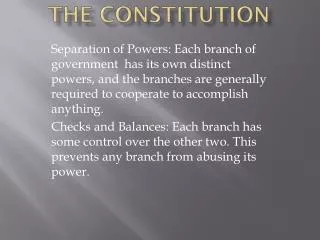
Checks and Balances • The framers of the Constitution established a system of checks and balances to prevent any branch government from getting too powerful. • Example: Congress has the right to pass bills into law, but the president can veto them, which means the bill does not become a law.
Federalism • The power of government is also split between the states and the federal government. • This is called Federalism. • If the Constitution does not have a law, the states can do what they want. • State law cannot contradict federal law, or a Supreme Court Opinion. They must be follow by the letter.
Dual Sovereignty • Dual Sovereignty means that whatever the federal government does not make a law about, the states can act however they choose. • That is why there is different state laws regarding the age of drinking alcohol, driving, the death penalty, and many more.