Download
1 / 33
330 likes | 461 Vues
This talk by Kevin Graham from Queen's University details the latest developments in neutrino research at the Sudbury Neutrino Observatory (SNO). It covers key topics such as the properties of neutrinos, various detection techniques including long and short baseline experiments, atmospheric and solar neutrinos, and the significance of oscillation phenomena. The discussion also addresses the SNO physics program, experimental results, detector calibration, and systematic uncertainties influencing measurements. This comprehensive overview is pivotal for understanding the future of neutrino physics.

E N D
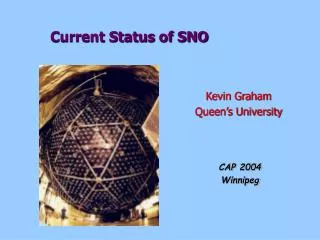
Current Status of SNO Kevin Graham Queen’s University CAP 2004 Winnipeg
Neutrinos: simple particles No charge - no mass - only weak interactions g Missing for most experiments
Well…Not ReallyWhat do we want to know and how? • Long Baseline • Short Baseline • Off-axis • Atmospheric • Solar • Reactor • Double Beta Decay • Supernova • Verify flavour change • Oscillation Signal • Measure mass splittings/hierarchy • Mixing angles • How many types? • Sterile? • Majorana? • Measure individual mass eigenstates • CP violation? • Magnetic moment? Solar measuring q12, Dm12
If neutrinos have mass: Using the oscillation framework: For three neutrinos: Maki-Nakagawa-Sakata-Pontecorvo matrix (Double b decay only) ? ? ? Solar,Reactor Atmospheric CP Violating Phase Reactor... Majorana Phases Range defined for Dm12, Dm23 For two neutrino oscillation in a vacuum: (valid approximation in many cases)
SNO Physics Program • Solar Neutrinos • Electron Neutrino Flux • Total Neutrino Flux • Electron Neutrino Energy Spectrum • Day/Night effects • Seasonal variations • Periodicity • hep neutrinos • Atmospheric Neutrinos & Muons • Downward going cosmic muon flux • Upward going muons and angular dependence • Supernova Watch • Antineutrinos • Nucleon decay (“Invisible” Modes: N nnn) Focus for this talk
Experimental Results SAGE+GALLEX/GNO Flux = 0.58 SSM Homestake Flux = 0.33 SSM Kamiokande+Superkamiokande Flux = 0.46 SSM SNO (CC 0.35) Flux = 1 SSM F = 6.6 × 1010 cm-2 sec-1 Solar Neutrinos
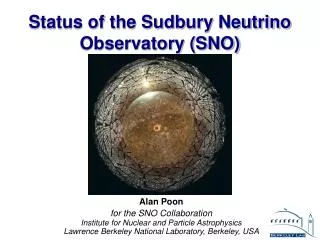
The SNO Detector 9438 Inward- Looking PMTs 2039 m to surface 91 Outward Looking PMTs (Veto) 12 m diameter Acrylic vessel Norite Rock PMT Support Structure (PSUP) 5300 tonnes light water 1000 tonnes heavy water 1700 tonnes light water
n + + + n NC d p n x x Neutrino Reactions in SNO n + + + CC d p p e− e • Q = 1.445 MeV • good measurement of ne energy spectrum • some directional info (1 – 1/3 cosq) • ne only • Q = 2.22 MeV • measures total 8B n flux from the Sun • equal cross section for all n types + + n e− n e− ES x x • low statistics • mainly sensitive to ne, some n and n • strong directional sensitivity
Spectrum Holanda, Smirnov Hep-ph 0212270 5% CC/NC Contours Day – Night Contours (%)
SNO Data Taking Phases Phase II (salty D2O): 254.2 (~400) days Te > 5.5 MeV R < 550 cm 3055 events (~4700) n capture on Cl Multiple g’s 8.6 MeV High CC-NC corr. Te unconstrained Phase III (3He n counters): n capture on 3He n + 3He g p + t Channels indep. gno correlation Reduced NC systematics Phase I (pure D2O): 306.4 live days Te > 5 MeV R < 550 cm 2928 events n capture on D Single 6.25 MeV g High CC-NC corr. Te constrained Counters in Publishing soon Past Present Future
What We Measure PMT Measurements • position • charge • time Reconstructed Event -event vertex -event direction -energy -isotropy
Detector Calibration Optics Energy Event Reconstruction Neutron Capture Backgrounds Tools Pulsed Laser 337nm to 620 nm 16N 6.13 MeV g’s 3H(p,g)4He 19.8 MeV g’s 8Li <13.0 MeV b’s 252Cf neutrons U/Th 214Bi & 208Tl b-g’s Monte Carlo
Pure D2O phase Optical Measurements from Laserball • Optical Constants • alaser at 6 wavelengths • ascan through detector • D2O Attenuation • H2O+AV attenuation • PMT Angular Response • Rayleigh Scattering Salt phase • Calibration used for • MC simulation • Energy calibration • Check systematics
Energy Calibration 16N at centre of detector refelections Data MC s=1.46 ns • Timing Cut • Prompt Time • 20 ns time window • reduce noise/model uncertainties • Energy Calibration • Detector State Corrections • Optical Correction to Centre • DatagMC 16N to set scale
Energy Calibration • generate MC electrons • energies from 2-30 MeV • create ‘look-up’ table NhitsgEnergy • resolution function Resolution Function Nhit/MeVTable sE =A + B(TE)0.5 + C TE
Energy Systematics Sources Include: Detector State Stability a16N centre Optical Model Radial/Asymmetry Timing MC model Total Uncertainty ~1%
g n 36Cl* 36Cl 35Cl Neutrons in Salt g NaCl Capture • Higher capture cross section • Higher energy release • Many gammas s = 44 b 35Cl+n s = 0.0005 b 8.6 MeV 2H+n 6.0 MeV 3H 36Cl
Neutron Capture Efficiency in SNO 35Cl(n,g)36Cl Average Eff. = 0.399 Te≥ 5.5 MeV and Rg ≤ 550 cm 2H(n,g)3H Average Eff. = 0.144 Te≥ 5.0 MeV and Rg ≤ 550 cm Total Systematic Uncertainty ~3%
Cerenkov Light and Isotropy Legendre Polynomials Use: b14 = b1 + 4b4 Systematic Uncertainty ~1% Use for Signal Extraction Charged particle, v > c/n qik 1cone qij >1cone
D2O Radioactivity Assays Controlled radon spike • Radon assay collection points • Top of AV • 2/3 up • Bottom of AV • Radium Assay techniques • MnOx • HTiO <1 n/day bkg
SignalBkg } CC NC ES Fe Fmt Cerenkov Photodis. FitFix Perturb Shift Variables PDF’s Signal Extraction Unconstrained NC E higher Less Rad. Sep. Variables: E, R3, cosqsun, b14 8B Shape Constrained Energy R3 qij cosqsun b14 Extended ML Fit aFluxes aSystematic Uncertainties Directionality Unchanged Isotropy Separation
Measured distributions Measure External n background Position Kinetic Energy Direction Isotropy
Results from Phase I & II CC 1339.6 #EVENTS +69.8 +63.8 +23.9 +20.1 +69.0 +61.5 NC 1344.2 ES 170.3 3055 candidate events 254 live days a 8B shape constrained 8B shape unconstrained Pure D2O (phase I) Salt (phase II)
Global analysis of solar and reactor neutrino data --90% --95% --99% --99.73% LMA I allowed only at 99.73% c.l. Maximal mixing rejected at 5.4 s
SNO Phase III (NCD Phase) Underway x n • 3He Proportional Counters (“NC Detectors”) 40 Strings on 1-m grid 440 m total active length Detection Principle 2H + x p + n + x - 2.22 MeV (NC) 3He + n p + 3H + 0.76 MeV PMT Physics Motivation Event-by-event separation. Measure NC and CC in separate data streams. Different systematic uncertainties than neutron capture on NaCl. NCD array removes neutrons from CC, calibrates remainder. CC spectral shape. NCD
5 cm Cu anode wire (50 m) 3He-CF4 gas mix Length of NCD Strings: 911 m Fused silica insulator CVD nickel counter body (0.36 mm thick) Delay line termination Vectran braid Acrylic ROV ball Acrylic anchor ball NCD Design and Response 3He + n p + 3H + 0.76 MeV
Why Event-by-Event? cc/nc correlation ~ -50% ~0
Summary Pure D2O Phase: Flavour Transformation Neutrinos Massive SSM working well Salt: Increased NC statistics Additional Isotropy Separation Precision Fluxes with No Shape Constraint Improved CC/NC Measurement gFull Salt Data Set (another ~140 days) gDay/Night - Spectral Shape – Eccentricity gImproved oscillation parameter precision Next Phase:NCDs going in (3He counters) event-by-event separation Improved systematics No CC-NC correlation Global Results: g LMA Favoured Global Results: Lower LMA Region Not Maximal Mixing