Optical Catalogue of Post-AGB Candidates: Stellar Evolution and Multiwavelength Analysis
This study presents an extensive optical catalogue of post-Asymptotic Giant Branch (post-AGB) candidates, focusing on stars transitioning to planetary nebulae (PN). Conducted by Olga Suárez under the supervision of Minia Manteiga Outeiro and Pedro García Lario, the project included a multiwavelength analysis, utilizing spectral energy distributions (SEDs) and statistical tools. The catalogue comprises 255 observed objects, including 104 confirmed post-AGB stars, 21 transition objects, and 36 PN. Criteria for selection were based on IRAS colors and flux ratios, aiding in understanding stellar evolution in this critical phase.

Optical Catalogue of Post-AGB Candidates: Stellar Evolution and Multiwavelength Analysis
E N D
Presentation Transcript
Or... “An optical catalogue of post-AGB candidates” Stellar evolution in the post-AGB stage Olga Suárez Laboratorio de Astrofísica Espacial y Física Fundamental – Madrid (Spain) Supervisors: Minia Manteiga Outeiro Pedro García Lario In colaboration with: Arturo Manchado, Ana Ulla, S.R. Pottasch
Objectives • Study of stars in the transition phase from AGB to PN. • Catalogue - large number of objects • Multiwavelength study - SEDs • Use of statistical tools
Objectives • Study of stars in the transition phase from AGB to PN. • Catalogue - large number of objects • Multiwavelength study - SEDs • Use of statistical tools
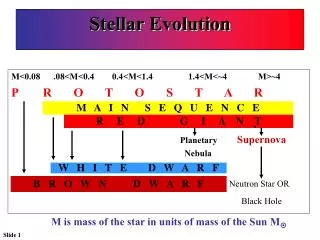
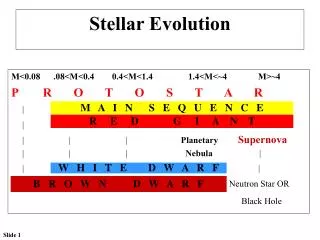
Post-AGB evolution (Blöcker, 1995)
Nomenclature used in this work • Post-AGB: AGB mass loss has ceased. not ionized envelope • Transition objects: stellar continuum forbidden lines (no [OIII]) • Planetary Nebula (PN): no stellar continuum forbidden lines
The catalogue - Selection criteria • IRAS colours: • [12] – [25] = 2.5 log (F12m/F25m) • [25] – [60] = 2.5 log (F25m/F60m) • Flux ratios: • F12m /F25m 0.50 • F25m/F60m 0.35 • F60m/F100m 0.60 • Low IRAS variability to avoid AGBs
The catalogue - the search Hα - cont Hα
The catalogue - the search IRAS 17395-0841 Hα [NII] Riera et al., RevMexAA, 2003 Suárez et al., in preparation Hα
The catalogue - number of objects • 255 observed objects • 104post-AGB stars (with optical spectra) • 21 transition objects • 36Planetary Nebulae • 3 AGB stars • 38 young stellar objects or HII regions • 2 Seyfert galaxies • 5 peculiar stars • 47 objects without optical counterpart (42 believed to be obscured post-AGB stars)
Analysis of the spectra • Spectral classification of post-AGB stars and young stellar objects. • Comparison with catalogues (Silva, 1992; Pickles, 1998; Jacoby, 1984) Relative flux Wavelength
Analysis of the spectra • Excitation classes for PNe (Morgan, 1984; Dopita, 1990; and Crowther, 1998) • Based on strength line ratios.
Spectral Energy Distributions • Data from optical spectra, 2MASS, MSX, IRAS. • Classification according to van der Veen et al. (1989) Class I Class II Class III Class IVa Class IVb
IRAS colour-colour diagram • Models by van Hoof et al. (1997), based on Blöcker (1995), show the evolution in this diagram.
Conclusions • Observations - selection criteria based on IRAS colours • Catalogue - 255 sources: 104 post-AGB stars, 21 transition objects, 36 PNe. • Spectra and SEDs classified - multiwavelength analysis using statistical tools
Galactic latitude distribution • Statistical indicator of the mass of a population of stars. • High latitude (wide galactic latitude distribution) lower mean mass • Low latitude (narrow galactic latitude distribution) higher mean mass
Results • Evolutionary status + Galactic latitude + statistics Post-AGB stars and PNe have different galactic latitude distributionfrom obscured post-AGB stars Objects without optical counterpart are obscured post-AGB stars similar to those not observed
Conclusions • Observations - selection criteria based on IRAS colours • Catalogue - 255 sources: 104 post-AGB stars, 21 transition objects, 36 PNe. • Spectra and SEDs classified - multiwavelength analysis using statistical tools