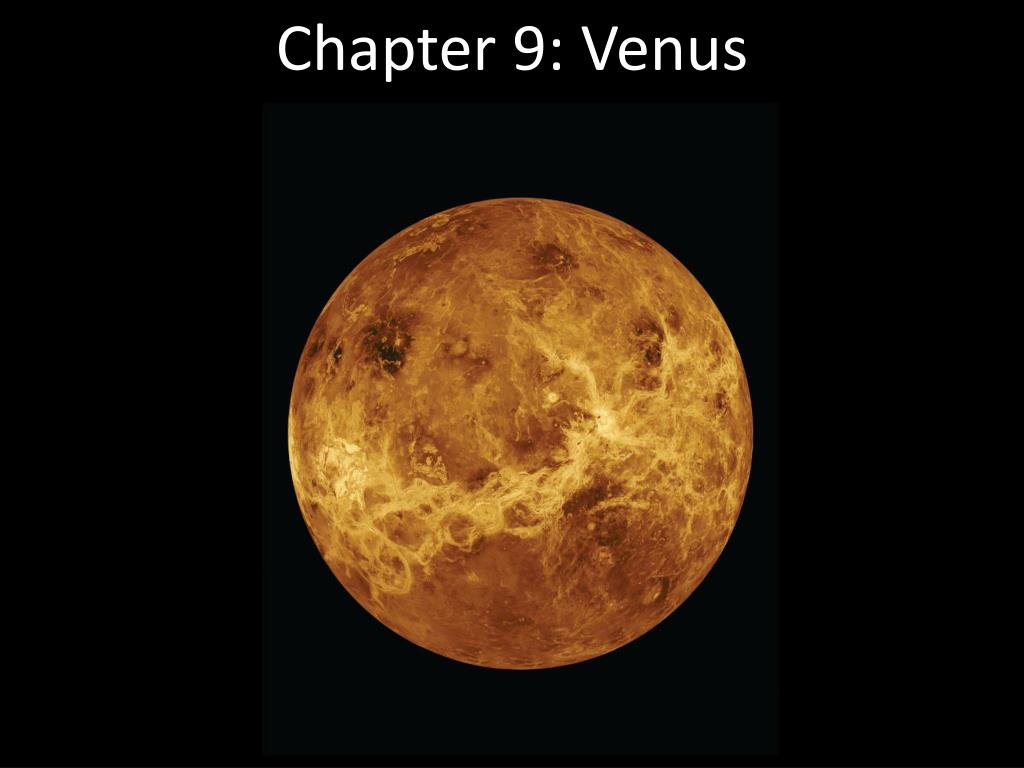
Chapter 9: Venus
Units of Chapter 9 9.1 Orbital Properties 9.2 Physical Properties 9.3 Long-Distance Observations of Venus 9.4 The Surface of Venus 9.5 The Atmosphere of Venus 9.6 Venus’s Magnetic Field and Internal Structure
9.1 Orbital Properties • Venus is much brighter than Mercury, and can be farther from the Sun • Called morning or evening star, as it is still “tied” to Sun • Brightest object in the sky, after Sun and Moon
Apparent brightness of Venus varies, due to changes in phase and distance from Earth
9.2 Physical Properties • Radius: 6000 km • Mass: 4.9 x 1024 kg • Density: 5200 kg/m3 • Rotation period: 243 days, retrograde
Slow, retrograde rotation of Venus results in large difference between solar day (117 Earth days) and sidereal day (243 Earth days); note that the solar day is a large fraction of the year, and the sidereal day is even longer than the year.
9.3 Long-Distance Observations of Venus Dense atmosphere and thick clouds make surface impossible to see Surface temperature is about 730 K—hotter than Mercury!
Even probes flying near Venus, using ultraviolet or infrared, can see only a little deeper into the clouds
9.4 The Surface of Venus Surface is relatively smooth Two continent-like features: Ishtar Terra and Aphrodite Terra No plate tectonics Mountains, a few craters, many volcanoes and large lava flows
Surface mosaics of Venus
Surface maps of Venus, with Earth comparison
Ishtar Terra is one of two continent-sized features on the surface of Venus
The other is Aphrodite Terra
Lava has flowed from cracks on the surface
Volcanoes on Venus; most are shield volcanoes
Other volcanic features include lava domes and coronas
Impact craters on Venus, the largest named after Margaret Mead
Photographs of the surface, from the Venera landers
9.5 The Atmosphere of Venus Venus’s atmosphere is very dense Solid cloud bank 50–70 km above surface Atmosphere is mostly carbon dioxide; clouds are sulfuric acid
Upper atmosphere of Venus has high winds, but atmosphere near surface is almost calm
There are also permanent vortices at the poles; the origin of the double-lobed structure is a mystery
Venus is the victim of a runaway greenhouse effect—just kept getting hotter and hotter as infrared radiation was reabsorbed
9.6 Venus’s Magnetic Field and Internal Structure No magnetic field, probably because rotation is so slow No evidence for plate tectonics Venus resembles a young Earth (1 billion years)—no asthenosphere, thin crust
The rotational period of Venus was measured by watching surface features move across the planet's disk. measuring the speed of clouds in the planet's atmosphere. measuring the Doppler shift of radar signals bounded off the planet's surf. orbiting spacecraft around the planet.
How is it possible that Venus's surface may be hotter than Mercury's? It is closer to the sun. Venus's larger area absorbs more heat. Venus rotates in a retrograde direction. Venus's lack of atmosphere allows sunlight to hit the surface without reflection. Venus has quite a lot of carbon dioxide in its atmosphere.
The atmosphere near the surface of Venus is: almost completely opaque. nearly transparent. about like a dense fog on Earth. unknown since we have not explored the surface of Venus.
The fact that Venus has little or no magnetic field is attributed to its slow rotation. its cloud cover. its proximity to the sun. its proximity to Earth. the greenhouse effect.
Venus was once considered to be Earth's sister planet because: it is the closest planet to Earth. it is similar in size. it has a similar mass. it has an atmosphere. all of the above.
How does the surface pressure on Venus compare to that on the Earth? • It is much less. • It is about the same. • It is much greater. • It is negligible.
The temperature of the surface of Venus is closest to _____ degrees Fahrenheit. • 100 • 500 • 1,000 • 10,000
Detailed photographs of surface features of Venus: do not exist. exist as the result of venera photographs of a very few limited areas. exist in abundance because of robot landers. exist in abundance because astronauts and cosmonauts landed on the surface.
Summary of Chapter 9 • Venus is never too far from Sun and is the brightest object in the sky (after the Sun and Moon) • Atmosphere very dense, mostly carbon dioxide • Surface hidden by cloud cover • Surface temperature 730 K • Rotation slow and retrograde
Summary of Chapter 9 (cont.) • Many lava domes and shield volcanoes • Venus is comparable to Earth in mass and radius • Large amount of carbon dioxide in atmosphere, and closeness to Sun, led to runaway greenhouse effect and very hot surface