Understanding Absolute Value Functions: Distance and Solutions in Equations
This guide explores absolute value functions, emphasizing their definition as the distance from a number to zero on a number line. It explains how to solve absolute value equations by considering both positive and negative cases, while also warning about extraneous solutions. Check your answers by substituting back into the original equation or using graphing techniques. The summary highlights the need to verify solutions, emphasizing that each equation typically has more than one answer. Use graphical intersections to validate your results.


Understanding Absolute Value Functions: Distance and Solutions in Equations
E N D
Presentation Transcript
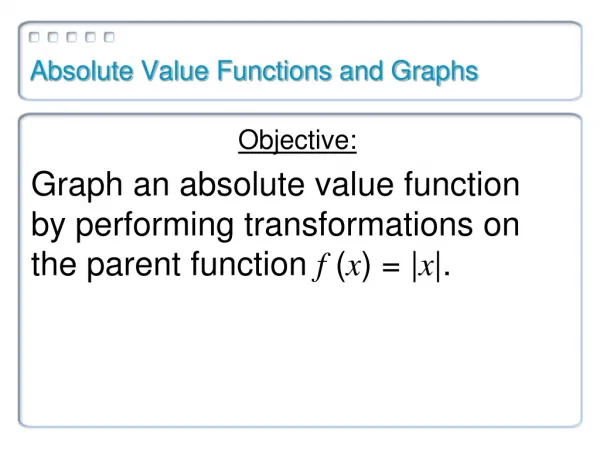
Absolute value • =-(-3) • If c is a real number, then is the distance from c to 0 on the number line • The distance from the origin
For example, =8 can be read as the distance from x to 4 is 8 units
properties • c=3;
solving • Solved by using the definitions • Graphing techniques are also an important part! • GO JAGUARS!!! • There are two answers to most absolute value equations. You must solve for the positive case and the negative case…but math student be aware… • THERE ARE FAKE SOLUTIONS!
Fake solutions • Commonly called extraneous solutions • What is an extraneous solution? • Some solutions do not make the original equation true when checked by substitution • What to do? • CHECK ALL SOLUTIONS BY SUBSITUTING BACK IN, OR BY GRAPHING!
EXAMPLE • Think back to the first example: • We said this read as, the distance from x to 4 is 8 units • Two choices for an answer • One is positive, one is negative • When you solve, you take both into account
Now check it! • Put in Calculator as 2 equations • Look at the points on the graph where the lines intersect. The x values of the intersection must match your answer or it is an extraneous root! • Go to Calculator! • OH yeah….GO JAGUARS!
Summary • Each absolute value equation can be though of as an x value a certain distance from a certain point • Therefore, there is typically more than one answer • Sometimes there are fake answers • Check in calculator • Plug in left side of equation for y1 • Plug in right side of equation for y2 • Look for intersection points • These must match your answers • If they do not, the root is extraneous