
SlideServe
Menu
Préférences
© SlideServe · v2026

Reflexes

brody-ayers avatar
14 diapositives · 678 Views · Nov 28, 2014

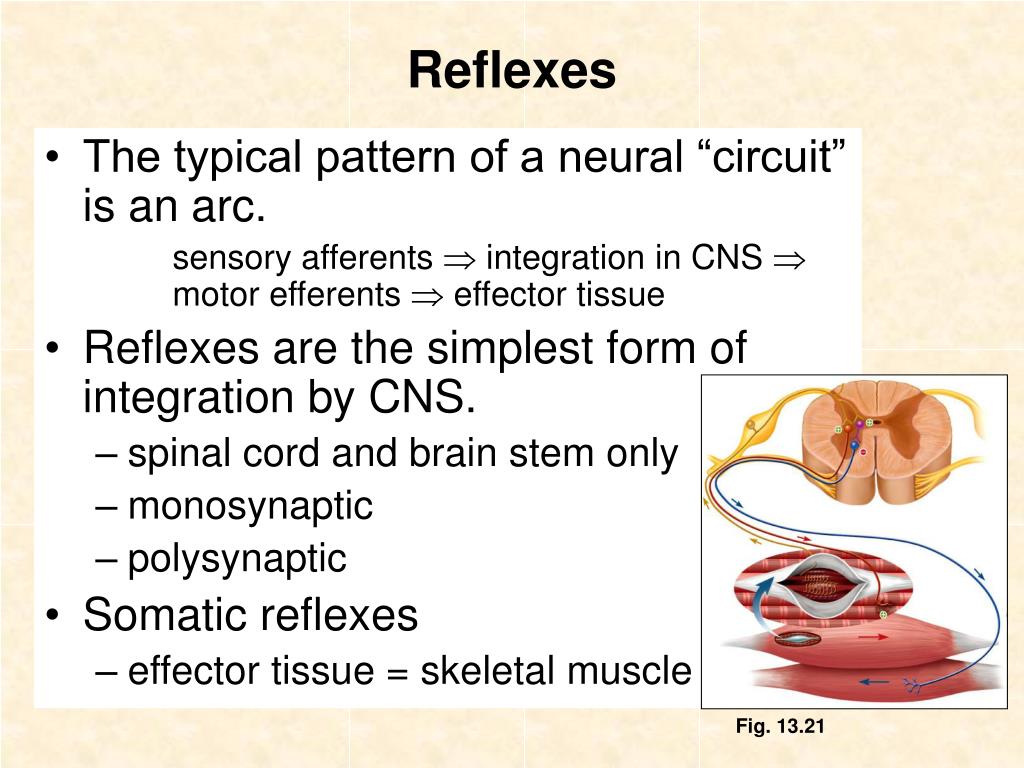
Reflexes. The typical pattern of a neural “circuit” is an arc. sensory afferents  integration in CNS  motor efferents  effector tissue Reflexes are the simplest form of integration by CNS. spinal cord and brain stem only monosynaptic polysynaptic Somatic reflexes
Reflexes - slide 1
01 / 14Reflexes
1 / 17

Télécharger la présentation

Reflexes
Une image / un lien ci-dessous est fourni (tel quel) pour télécharger la présentation

Politique de téléchargement : le contenu du site vous est fourni TEL QUEL pour votre information et votre usage personnel ; il ne peut être vendu, concédé sous licence ni partagé sur d’autres sites sans l’accord de son auteur.Le contenu vous est fourni TEL QUEL, pour votre information et votre usage personnel uniquement. Téléchargez la présentation en cliquant sur ce lien. Lors du téléchargement, si vous ne parvenez pas à télécharger une présentation, l’éditeur a peut-être supprimé le fichier de son serveur.Pendant le téléchargement, si vous ne parvenez pas à obtenir une présentation, le fichier a peut-être été supprimé par l’éditeur.

F I N

Plus de contenu associé

Transcription de la présentation
  1. Reflexes • The typical pattern of a neural “circuit” is an arc. sensory afferents  integration in CNS  motor efferents  effector tissue • Reflexes are the simplest form of integration by CNS. • spinal cord and brain stem only • monosynaptic • polysynaptic • Somatic reflexes • effector tissue = skeletal muscle Fig. 13.21

  2. Skeletal Muscle Proprioceptors • Muscle Spindles • detect muscle length • inhibit muscle stretch • Golgi Tendon Organs • detect muscle tension • inhibit over-contraction

  3. Golgi Tendon Organ Type Ib fibers Fig. 13.23

  4. Muscle Spindles fus- = spindle intrafusal fibers – specialized muscle fibers of the spindle extrafusal fibers – regular skeletal muscle fibers A Type Ia fiber A Type II fiber Fig. 13.20

  5. Muscle Spindles • The (Ia) sensory nerve ending is a stretch receptor, wrapped around the center of an intrafusal fiber. • The intrafusal fibers have sarcomeres only on their ends. • A stimulation of intrafusal fibers will cause contraction of the ends and stretch of the middle. • There is always some tonic discharge by the A motor neurons. • Therefore, the stretch receptors are always slightly stimulated – warmed up and ready to respond to any stretch of the muscle. Fig. 6-3 Ganong

  6. Stretch Reflex • a monosynaptic reflex • e.g., the knee-jerk reflex A • negative feedback • ipsilateral stimulation • of extension • (simultaneous inhibition • of flexion – polysynaptic) Fig. 13.21

  7. via interneurons sensory neuron from skin  [interneuron(s)]  A motor neuron examples withdrawal (flexor) reflex crossed extensor reflex Polysynaptic Reflexes

  8. Withdrawal Reflex + = stimulatory -= inhibitory • a flexor reflex • ipsilateral • stimulation of flexion • inhibition of extension Fig. 13.22

  9. Crossed Extensor Reflex • an extensor reflex • contralateral • stimulation of extension • inhibition of flexion Fig. 13.22

  10. Somatic Motor Pathways(from brain) • organizing principles • phylogenetic • lateral and medial motor systems • medial tracts are more primitive (see ventral/anterior columns) • control proximal muscles: posture and gross movements • lateral tracts are more advanced • control distal muscles: fine, skilled movements • clinical • pyramidal and extrapyramidal systems • pyramidal system (direct pathway) • extrapyramidal systems (indirect pathways)

  11. Fig. 14.23 Somatic Motor System • The frontal lobe is a major control center for somatic motor functions. • precentral gyrus • 30-60% of cortical motor fibers originate here.

  12. Fig. 13.6 Pyramidal System • direct pathway • The axon of one neuron travels from the cerebral cortex to lower motor neurons (such as the A motor neurons). • two paths • lateral corticospinal tracts • ventral corticospinal tracts

  13. Fig. 12-2 Ganong • lateral corticospinal tracts • lateral motor system • major importance only in primates • precise control of voluntary movements in distal muscles • In humans, 80-90% of cortical motor fibers travel in these tracts. • cross over in the pyramids of the medulla • giving the “pyramidal” system its name • ventral corticospinal tracts • medial motor system • cross over (via interneurons) in the spinal cord, at the level of the lower motor neuron

  14. Medullary Pyramids Fig. 14.27 Fig. 14.9