
Exploring Phase Changes: Boiling, Melting, Freezing, Evaporation, and Condensation
E N D
Presentation Transcript
Phase Changes Looking at Boiling, Melting, and Freezing points, Evaporation and Condensation
Physical science series: phases of matter 18 min video • http://player.discoveryeducation.com/index.cfm?guidAssetId=CCAD037E-5E2D-4AC3-9929-090E6277C929&blnFromSearch=1&productcode=US
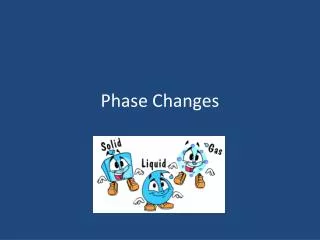
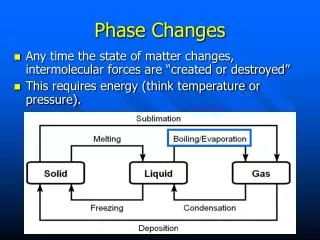
Phase Change • Matter can change from one phase to another. • This is called a Phase Change
Phase Changes • The amount of heat energy in any particular piece of matter can change. • A big enough change in heat energy causes a phase change. • Solids Liquids Gas • There are different names for each of the phase changes. Add Heat Energy Add Energy
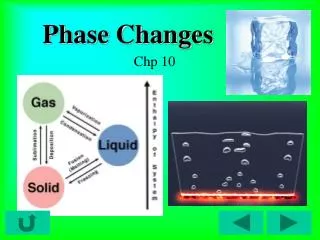
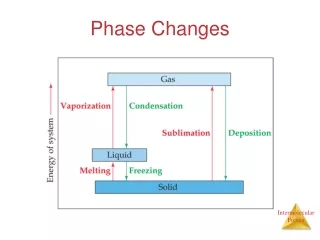
Melting- change from a solid to a liquid Vaporization – change from liquid to gas. Boiling Evaporation Condensation- change from a gas to a liquid. Freezing – change from a liquid to a solid. Sublimation – change from a solid to a gas Different names for each Phase Changevocabulary
Vaporization • Difference between boiling and evaporation • Evaporation – happens at the surface – usually due to sun’s energy. • Boiling happens within the liquid. Inside of liquid changes to a gas, this is why there are bubbles.
Decrease temp- Condensation Freezing Increase temp- Melting Sublimation Evaporation Boiling Phase Changes Phase Changes are Caused by either an increase or decrease in heat energy (temperature).
Phase Change Points • Each substance has a temperature that it changes phase at. • Different for all substances! • For example, freezing point for water is 0ºC. The freezing point for gold is approximately 1064ºC. • boiling point, freezing point, melting point, condensation point alldo not change if you have more or less of the substance.
Temperatures at which one state turns to another…… • BOILING POINT- liquid turns to gas • MELTING POINT – solid turns to liquid • FREEZING POINT – liquid turns to solid • BOILING POINT of water- 100 ˚ C (or above) • MELTING POINT of water - 0˚ C (or above) • FREEZING POINT of water- 0˚C (or below
Interactive matter phase change • http://www.miamisci.org/af/sln/phases/watersolid.html