Download
1 / 24
240 likes | 366 Vues
This theory outlines the formation of Earth's geological layers based on the concept of uniformitarianism, established by James Hutton and later expanded by William Whewell. Uniformitarianism posits that the processes shaping our planet today have remained consistent throughout history. This includes gravity's perpetual influence, the constant properties of elements, and the unchanging laws of physics. By examining sedimentary layers, we understand that older layers lie beneath younger ones—a key principle guiding geological studies. This framework enables scientists to propose theories on Earth's history confidently. ###

E N D
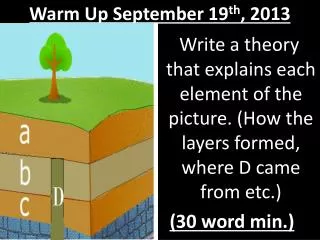
Warm Up September 19th, 2013 Write a theory that explains each element of the picture. (How the layers formed, where D came from etc.) (30 word min.)
In order for scientists to pose ANY theory on how we got here, SCIENTISTS ASSUME ONE THING.
It may seem obvious to some; to others, a sliver of uncertainty. For scientists to pose theories on how we got here, they must ASSUME ONE THING.
William Whewell in 1832 The CONCEPT of UNIFORMITARIANISM. William Whewell FRS FGS, was an English polymath, scientist, Anglican priest, philosopher, theologian, and historian of science. He was Master of Trinity College, Cambridge.
The CONCEPT of UNIFORMITARIANISM. James Hutton in 1785 a Scottish farmer and naturalist, is known as the founder of modern geology.
William Whewell in 1832 The CONCEPT of UNIFORMITARIANISM. James Hutton in 1785
UNIFORMITARIANISM* All forces have acted the same from the origin of the Earth to the present.
So, we assume… • Gravity has always existed.
So, we assume… • Gravity has always existed. • Elements and molecules have had the same properties for as long as our universe.
So, we assume… • Gravity has always existed. • Elements and molecules have had the same properties for as long as our universe. (density, conductivity) • Classic physics laws apply.
So, we assume… • Gravity has always existed. • Elements and molecules have had the same properties for as long as our universe. (density, conductivity) • Classic physics laws apply. (thermodynamic laws, math laws, momentum, acceleration, motion…) • However atoms work today, they’ve worked that way always.
So, we assume… • Gravity has always existed. • Elements and molecules have had the same properties for as long as our universe. (density, conductivity) • Classic physics laws apply. (thermodynamic laws, geometric laws, momentum, acceleration) • However atoms work today, they’ve worked that way always. (isotope degradation, speed of electrons)
Law of Superposition* - Sedimentary layers are deposited in a time sequence, with the oldest on the bottom and the youngest on the top.