Building a Redox Cell for Maximum Current: A Hands-on Experiment
60 likes | 197 Vues
In this project, you will construct a redox battery cell using chromium (Cr) and copper (Cu) to achieve the highest possible current. Understanding the oxidation and reduction processes is essential for success. The half-reactions will be examined, showcasing Cr → Cr³⁺ + 6e⁻ (oxidation) and Cu²⁺ + 2e⁻ → Cu (reduction). You will build at least three cells, documenting the design with a diagram and measuring the current produced. Analyze the flow of electrons through the anode and cathode, and explore the electrical potential difference achieved.


Building a Redox Cell for Maximum Current: A Hands-on Experiment
E N D
Presentation Transcript
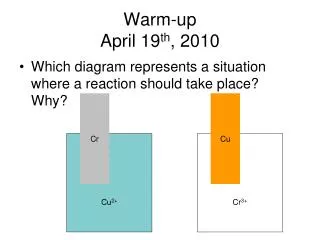
Warm-upApril 19th, 2010 • Which diagram represents a situation where a reaction should take place? Why? Cr Cu Cu2+ Cr3+
A Redox Reaction2 Cr + 3 Cu2+ 2 Cr3+ + 3 Cu Cr Two “half-reactions” 2 Cr 2 Cr3+ + 6 e- (oxidation) 3 Cu 2+ + 6 e- 3 Cu (reduction) Which one is oxidation and which one is reduction? Cu2+ e-
e- e- e- Anode Cathode 1.55 V Cr Cu Cr3+ Cu2+ Salt Bridge Which way are the electrons flowing? Anode – the electrode where the electrons are flowing in Cathode – the electrode where the electrons are flowing out
e- e- e- Anode Cathode 1.55 V Cr Cu Cr3+ Cu2+ Salt Bridge
e- e- e- Anode Cathode Voltage 1.55 V • Voltage: A measure of the electrical potential difference between two points • Current: Amount of charge transferred per unit time Cr Cu Cr3+ Cu2+ Salt Bridge
Your Task • Build a cell that will produce the greatest current possible given the materials. • Build at least three batteries • What you will hand in: • A diagram • How much current you were able to produce