SlideServe
Menu
Préférences
© SlideServe · v2026

Lecture 7: Recombination mapping

bryant avatar
16 diapositives · 729 Views · Jul 27, 2014

Lecture 7: Recombination mapping. Reminders:. Exam 1 is next Tuesday, 2/8 Quiz 1 grades are posted on the course website Quiz 1 key will be posted on the website by the end of Friday. Crossing over produces new combinations of alleles. Independent assortment: recombinant frequency = 50%.
Lecture 7: Recombination mapping - slide 1
01 / 16Lecture 7: Recombination mapping
1 / 17

Télécharger la présentation

Lecture 7: Recombination mapping
Une image / un lien ci-dessous est fourni (tel quel) pour télécharger la présentation

Politique de téléchargement : le contenu du site vous est fourni TEL QUEL pour votre information et votre usage personnel ; il ne peut être vendu, concédé sous licence ni partagé sur d’autres sites sans l’accord de son auteur.Le contenu vous est fourni TEL QUEL, pour votre information et votre usage personnel uniquement. Téléchargez la présentation en cliquant sur ce lien. Lors du téléchargement, si vous ne parvenez pas à télécharger une présentation, l’éditeur a peut-être supprimé le fichier de son serveur.Pendant le téléchargement, si vous ne parvenez pas à obtenir une présentation, le fichier a peut-être été supprimé par l’éditeur.

F I N

Plus de contenu associé

Transcription de la présentation
  1. Lecture 7:Recombination mapping

  2. Reminders: Exam 1 is next Tuesday, 2/8 Quiz 1 grades are posted on the course website Quiz 1 key will be posted on the website by the end of Friday

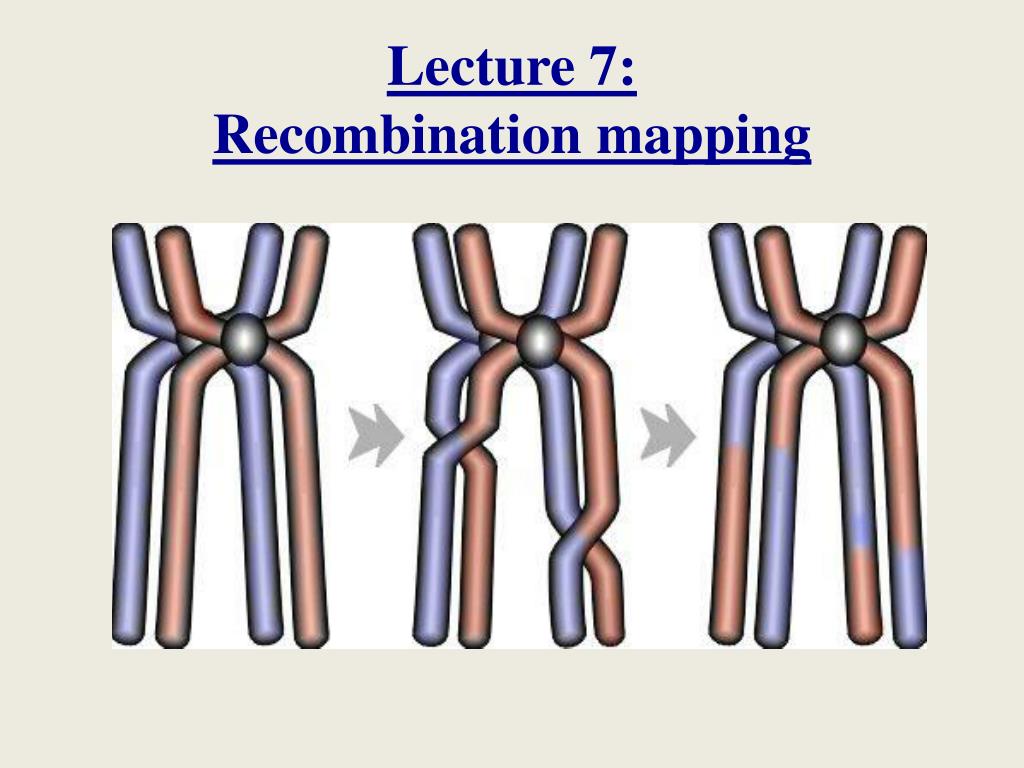
  3. Crossing over produces new combinations of alleles

  4. Independent assortment: recombinant frequency = 50% Complete linkage (no crossover): recombinant frequency = 0% Linkage with crossover: recombinant frequency = 0<x<50%

  5. Recombination frequency is proportional to the distance between two genes genes close together: few recombinants genes far apart: many recombinants

  6. Map units are based on recombination frequency

  7. Example 3-point test cross: 3 Drosophila alleles (autosomal): eye color: v (vermillion) or v+ (wild type, red) wing veins: cv (no cross vein) or cv+ (wild type) wing edges: ct (cut) or ct+ (wild type) P v+ /v+cv /cv ct/ct X v/vcv+/cv+ ct+ /ct+ Input gametes: v+ cv ct AND vcv+ ct+ F1 trihybridv+ /vcv+ /cv ct+ /ct TEST CROSS: v+ /vcv+ /cv ct+ /ctX v/vcv/cv ct/ct F1 trihybrid female tester male

  8. Example of a 3 point test cross Input gametes: v+ cv ct AND vcv+ ct+ F2 progeny:

  9. Step 1: identify non-crossover classes: NCO NCO

  10. Step 2: identify double crossover classes DCO DCO

  11. Step 3: calculate recombinant frequencies: R R R R DCO DCO

  12. Recombinant frequency for v and cv R R R R DCO DCO RF (v and cv) = (45 + 40 + 89 + 94 + 3 + 5) ÷ 1448 = 276 ÷ 1448 = .191 X 100% = 19.1%

  13. Recombinant frequency for v and ct R R DCO DCO RF (v and ct) = (89 + 94 + 3 + 5) ÷ 1448 = 191 ÷ 1448 = .132 X 100% = 13.2%

  14. Recombinant frequency for cv and ct R R DCO DCO RF (cvand ct) = (45 + 40 + 3 + 5) ÷ 1448 = 93 ÷ 1448 = .064 X 100% = 6.4%

  15. Step 4: construct the map highest recombination frequency means farthest apart Recombination frequency v and cv: 19.1 Recombination frequency v and ct: 13.2 Recombination frequency cv and ct: 6.4 v ct cv 13.2 m.u. 6.4 m.u.

  16. Short cut: using double recombinants to deduce gene order Double recombinants have the middle gene“flipped” relative to parental arrangement: parentals: vcv+ ct+ v+cv ct DCO’s: vcv+ ct v+cv ct+ must be in between v and cv