Download
1 / 9
90 likes | 212 Vues
This wellness baseline generator provides a structured approach to evaluating the health and well-being of various beings, including humans, dogs, horses, cats, and more. The assessment includes sections on physical, behavioral, emotional, cognitive, and intake/output factors. It encourages you to describe and rate each aspect, enabling informed goal setting for improved balance and wellness. This easy-to-use template helps track key health indicators over time and supports precise goal-oriented improvements with specific, achievable targets.

E N D
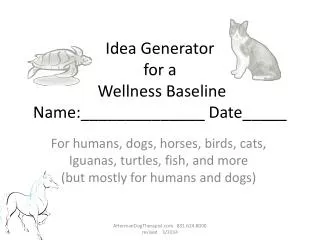
Idea Generator for a Wellness Baseline Name:______________ Date_____ For humans, dogs, horses, birds, cats, Iguanas, turtles, fish, and more (but mostly for humans and dogs) AHermanDogTherapist.com 831.624.8000 revised 3/2014
PHYSICALdescribe or rate, as you see fit • Movement • Structure (conformation/bone structure, etc.) • Breathing • Digestive • Skin • Hair/fur/feathers/scales • Sensory • Sight • Taste • Touch • Hearing • Smell • Any known issues/conditions AHermanDogTherapist.com 831.624.8000 revised 3/2014
BEHAVIORAL • Energy level (1=zero energy, 3= nice, even, 5=super hyper) • Interactivenessscale (1=not at all, 3=ideal 5=won’t leave others alone) • With other members of the family • With same species strangers • With different species strangers • Other notes • Hours of sleep/day • At night • Naps • Play scale (and what is play according to your definition?) (1=refuses to play, 3=plays nicely/appropriately, 5=non-stop insistence on play with everyone) AHermanDogTherapist.com 831.624.8000 revised 3/2014
Emotional • Happiness Scale (1=very unhappy, depressed 3=evenly, moderately happy, 5=off the charts, ecstatic all the time!) • Separation anxiety (yes, sometimes, no) • Fearfulness (Of what situations? What people?) • Protectiveness (In what situations? Of what and/or whom?) • Other emotions you wish to keep track of AHermanDogTherapist.com 831.624.8000 revised 3/2014
COGNITIVE • Comprehension level (1=no understanding of what you are asking for, 3=okay understanding, 5=extraordinary understanding) • Outgoing communications • By voice, body movements, eyes, etc. and note which are utilized the most • ESP or communications not explained above • Communications with same species (rate receptive and expressive, quality, and comprehension levels) • Communications with other species (rate receptive and expressive, quality and comprehension levels) AHermanDogTherapist.com 831.624.8000 revised 3/2014
Intake/Output • Foods typically eaten (list and incl. quantities, times of day, appetite level) • Supplements (list) • Water (type, quantities, times of day, level of thirst) • Output (stool, consistency, frequency) • Output (urine, color, quantity, frequency) AHermanDogTherapist.com 831.624.8000 revised 3/2014
Exercise and Typical Day • Type of exercise, time spent each day • Stamina/Energy level (1=none, 3=moderate, 5=high) • Describe a typical day for whoever’s baseline this is including time spent alone AHermanDogTherapist.com 831.624.8000 revised 3/2014
OTHER OBSERVATIONS (include social skills if not covered elsewhere, sense of spirituality if appropriate, plus any idiosyncracies, foods liked or disliked, etc….anything that explains or describes this being which hasn’t already been recorded) AHermanDogTherapist.com 831.624.8000 revised 3/2014
One or moreGoals for Improved Balance(Try just one or two!!! Make a short term goal and a long term goal in any category you wish to work on. Set dates to achieve goals. You can always push these ahead or add a new goal if one has been met. Be as specific as possible, make measureable goals, make them as realistic and timely as possible, and again, MOST IMPORTANT, just one or two which ARE ACHIEVEABLE!!! • Physical • Behavioral • Emotional • Cognitive • Input/Output • Exercise/Typical Day • Social • Other AHermanDogTherapist.com 831.624.8000 revised 3/2014