Download
1 / 6
60 likes | 186 Vues
This article discusses the evolution of internal battery backup systems using lithium-ion technology for medical devices, focusing on power consumption efficiency and safety measures. It highlights important metrics, including power outputs of 20W and 34W with efficiencies of 84% and 71%, respectively. The study also analyzes the thermal effects on tissue, demonstrating safe Specific Absorption Rates (SAR) when tested on goat tissue with no adverse effects. These developments signify a breakthrough in ensuring stable operation and high transmission efficiency for medical applications.

E N D
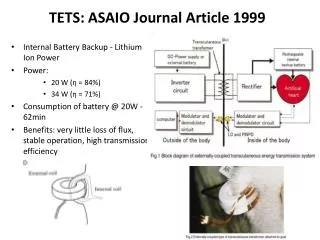
TETS: ASAIO Journal Article 1999 • Internal Battery Backup - Lithium Ion Power • Power: • 20 W (η = 84%) • 34 W (η = 71%) • Consumption of battery @ 20W - 62min • Benefits: very little loss of flux, stable operation, high transmission efficiency
TETS Safety • The power of electromagnetic wave absorbed by tissue per unit mass of 1 kg is used to evaluate the thermal effect (SAR) • Previous device: SAR = 0.3 W/kg @40 W • Safety level: SAR = 8 W/kg • Established by the Ministry of Public Management, Home Affairs, Posts and Telecommunications of Japan. • Tested on a goat with 20-40 W transmitted continuously for 4 months • No negative effects on the goat tissue • http://www.natureinterface.com/e/ni03/P081-082/ • Nature Interface Quarterly Magazine (Japanese)
TETS: ASAIO Journal Article 1993 • Maximum power output: • 60W @ 5mm (η = 75-80%) • 45W @ 15mm (η = 75-80%) • Induction coils: must be placed closely together and orientated correctly • Uses frequencies and “tunes” each coil providing power
TETS: ASAIO Journal Article 2000 • Power output: 27-30W • AC-AC: η = 97% • DC-DC: η = 84%
Thoratec TETS: ASAIO Journal Article 2004 • Max output of 45W • η = 80%
The AbioCor Total Artificial Heart System • Supplies power to Abiocor Total Artificial Heart • The TET system implemented is proprietary and getting rights would be nearly impossible • The total system costs ~$250K