Understanding Kinetics: Reaction Rates, Activation Energy, and Energy Diagrams
Explore the fundamentals of chemical kinetics, focusing on how reaction rates are influenced by the concentration of reactants. Learn about the concept of rate laws, which are determined experimentally, and the significance of activation energy—the minimum energy required to reach the transition state. Delve into reaction-energy diagrams to visualize one-step and two-step reactions, including the role of catalysts in lowering transition state energy. Understand the rate-limiting step and the importance of reaction intermediates in reaction mechanisms.

Understanding Kinetics: Reaction Rates, Activation Energy, and Energy Diagrams
E N D
Presentation Transcript
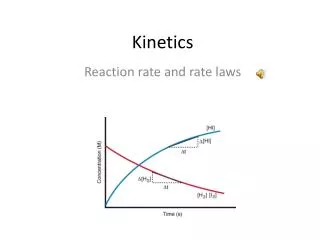
Kinetics • Answers question, “How fast?” • Rate is proportional to the concentration of reactants raised to a power. • Rate law is experimentally determined.=>
=> Activation Energy • Minimum energy required to reach the transition state. • At higher temperatures, more molecules have the required energy.
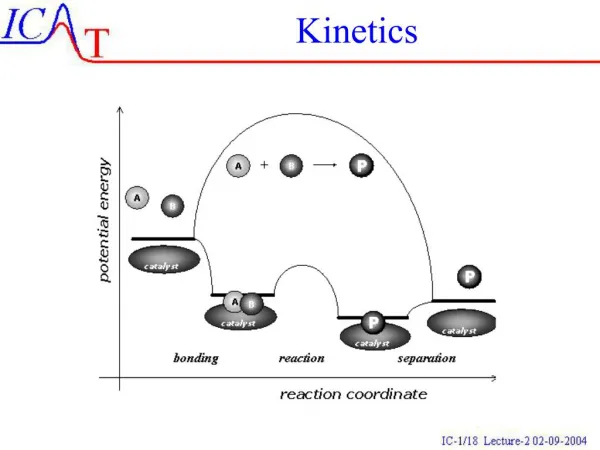
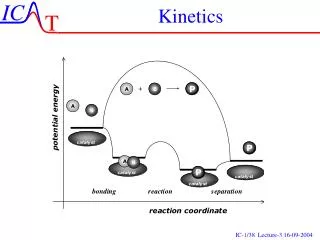
=> Reaction-Energy Diagrams • For a one-step reaction:reactants transition state products • A catalyst lowers the energy of the transition state.
Rate-Limiting Step • Reaction intermediates are stable as long as they don’t collide with another molecule or atom, but they are very reactive. • Transition states are at energy maximums. • Intermediates are at energy minimums. • The reaction step with highest Ea will be the slowest, therefore rate-determining for the entire reaction. =>
=> Energy Diagram for a Two-Step Reaction • Reactants transition state intermediate • Intermediate transition state product