Understanding Reaction Rates and Rate Laws in Chemical Kinetics
This overview covers the essential concepts of reaction rates and rate laws in chemical kinetics. It explains how reaction rates can be expressed based on changes in reactant concentrations over time, highlighting the dependence on the concentrations of reactants. The concepts of rate constants, orders of reaction, and the significance of integrated rate laws for zero, first, and second-order reactions are discussed. Additionally, it covers the determination of reaction order through experimental data, emphasizing the role of catalysts and the relationship between half-life and rate constants.

Understanding Reaction Rates and Rate Laws in Chemical Kinetics
E N D
Presentation Transcript
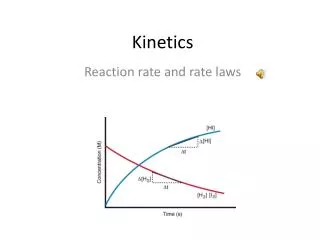
Kinetics Reaction rate and rate laws
Reaction rate: rate = Δ concentration of species Δt aA + bB → cC + dD rate = Δ[C] = Δ[D] = -Δ[A]= -Δ[B] cΔt dΔt aΔt bΔt
Dependence on concentration of reactants: single reactant, A: rate = k[A]m; k = rate constant, m = order two reactants, A & B: rate = k[A]m[B]n m + n = overall order Generally, m and n are positive integers but can be zero or fractions.
Two important things about this form of the rate law: 1. The concentrations of the products do not appear in the rate law b/c the reaction rate is being studied under conditions where the reverse reaction does not contribute to reaction rate. 2. The values of m & n must be determined by experiment.
Determination of m and k from rate-concentration data: CH3CHO(g) → CH4(g) + CO(g) rate [CH3CHO] 2.0 M/s 1.0 M 0.5 M/s 0.50 M 0.080 M/s 0.20 M
rate1 = k[A]1m = [A]1m rate2 k[A]2m [A]2 2.0 / 0.50 = (1.0/0.50)m 4.0 = 2.0m m = 2 so rate = k[CH3CHO]2 plug any data set back in to solve for k.
Integrated rate laws: zero order reactions: [A] = [A]o - kt plot of [A] vs. t is linear slope = -k, b = [A]o first order reactions: ln[A] = ln[A]o - kt plot of ln[A] vs t is linear slope = -k, b = ln[A]o
second order reactions: 1/[A] = kt + 1/[A]o plot of 1/[A] vs. t is linear slope = k, b = 1/[A]o
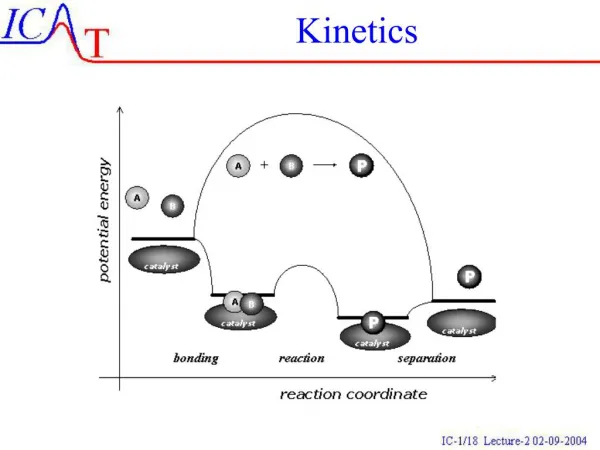
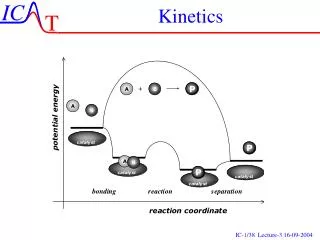
Zero order reactions most often involve a catalyst. When the catalyst is completely in use the concentration of reactants does not matter. When the same reaction occurs with no catalyst, the reaction is not zero order. For first order reactions: t1/2 is independent of the original concentration t1/2 is inversely related to k. If t1/2 is small, k is large and vice versa
Here is the notes quiz https://docs.google.com/spreadsheet/embeddedform?formkey=dHhnUlQyTmFDREUzWmg4Qncwc2JRcUE6MQ