Download
1 / 19
190 likes | 335 Vues
This comprehensive overview explores the attachment theories of John Bowlby and Mary Ainsworth, highlighting the importance of caregiver-child relationships. It discusses the effects of maternal separation on children, attachment stages, and behaviors such as protest, despair, and detachment. Delve into Bowlby's innate theories influenced by imprinting and Ainsworth's Strange Situation assessment. The document also addresses factors promoting or hindering attachment, different types of attachment, and implications for parenting and child development strategies.

E N D
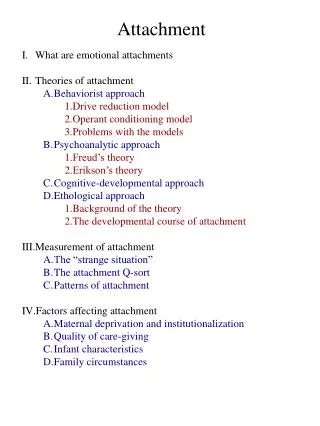
Attachment overheads Class Notes
Attachment • Theories of John Bowlby • Parent-child relationship • What happens when children are raised in relative states of maternal separation? • Films – institutionalized children staying in hospital wards. • Three-phase separation behaviors resulted.
Attachment • Issue: universality of stages. • Stages: • Stage one: Protest • Stage two: Despair • Stage three: Detachment
Attachment • Bowlby felt that the mother-child bond was adaptive – important for survival. • Bowlby was very influenced by Karl Lorenz and his work on imprinting – innateness and adaptiveness of behaviors. • Bowlby felt that attachment was innate on the part of the infant and caregiver.
Attachment • Certain behaviors connected with attachment. • Critical or sensitive period for the development of attachment. • Monotrophy – main attachment figure. • Model for future relationships.
Attachment • Mary Ainsworth – conditions that activate children’s attachment systems. • Strange situation – baby in an unfamiliar room with a stranger.
Attachment • Eight episodes measured four behaviors. • Willingness to explore • Separation anxiety • Stranger anxiety • Reunion Behavior
Attachment Definition of attachment – put slide up here.
Attachment • Infant Characteristics that promote Attachment: • “kewpie doll” appearance • Rooting, sucking, grasping reflexes • Cooing, babbling • Smiling • Crying • Responsiveness to social overtures
Attachment • Infant Characteristics that make attachment difficult • Physically unattractive (e.g.) premature • Reflexes weak • Irritable, few smiles • Little pleasant vocalization • Irritating shrill • Easily over stimulated, resists or ignores social overtures.
Attachment • Caregiver characteristics that hinder attachment • Maternal depression • Abused mother • Mother does not want baby • Mother unable to take lead in establishing interactions • Mother insensitive to infant cues and may under or overstimulate child.
Attachment • Several children in family • Poor marital relationship.
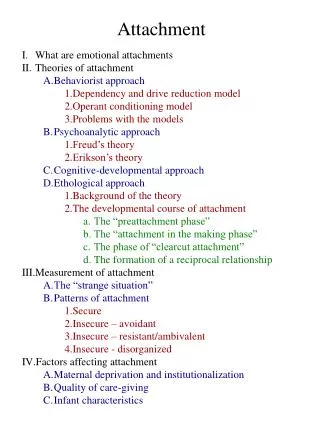
Attachment • Schaffer and Emerson Stages in Social Attachment • Asocial stage – 0-6 weeks • Indiscriminate attachment stage – 6 wks to 6-7 months • Specific attachment stage – 7-9 months • Multiple attachment stage – shortly after stage 3
Attachment • Theories of attachment: • Psychoanalytical Theory • Learning Theory • Ethological Theory
Attachment • What does the research say about attachment?
Attachment • Types of Attachment • Secure Attachment • Insecure Attachment (anxious / resistant) • Insecure Attachment (anxious / avoidant) • Insecure Attachment (disorganized / disoriented)
Attachment • Ainsworth’s Caregiving Hypothesis • Quality of attachment dependent on attention, responsiveness, sensitivity. • Inconsistent caregiving leads to insecure attachment (anxious / resistant) • Impatient caregiving leads to anxious and avoidant attachment. • Abusive caregiving leads to disorganized / disoriented attachment.
Attachment • Kagan’s Temperament Hypothesis • Quality of infant’s attachment dependent upon: • Easy temperment = secure attachment • Difficult temperment = insecure (anx/res) • Slow to warm up temperment = insecure (anx / avoidant) • Research evidence?
Attachment • Symptoms of a reactive attachment disorder – see handout on the website. • What can we do to help? • Provide highly predictable environment. • Avoid intimacy too soon. • Holding therapy? • Failure to thrive cases. • Reparenting work.