Understanding Countable and Noncountable Nouns: A Comprehensive Guide
This guide explores the fundamental differences between countable and noncountable nouns in English. Countable nouns, such as "book" and "man," have singular and plural forms, while noncountable nouns, like "water" and "bread," are always used in the singular. Learn how to correctly use quantifiers to ask questions and form negative statements. For countable nouns, use "how many?" and in the negative form, "there aren't many." For noncountable nouns, use "how much?" and the negative "there isn't much." Enhance your grammar skills with this clear explanation.

Understanding Countable and Noncountable Nouns: A Comprehensive Guide
E N D
Presentation Transcript
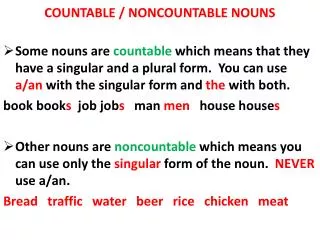
COUNTABLE / NONCOUNTABLE NOUNS • Somenouns are countablewhichmeansthat they have a singular and a plural form. You can use a/an with the singular form and the with both. book books job jobs man men house houses • Other nouns are noncountable which means you can use only the singular form of the noun. NEVER use a/an. Bread traffic water beer rice chicken meat
QUANTIFIERS How many? PLURAL COUNTABLE NOUNS (way) too many Not many Only a few How much? UNCOUNTABLE NOUNS (way) too much don’t have a plural form Only a little not much Not enough A lot of with both kinds of nouns Lots of
HOW MUCH / HOW MANY WITH PLURAL COUNTABLE NOUNS IN Qs & NEGATIVE HOW MANY PEOPLE ARE THERE? THERE AREN’TMANY. / THERE AREN’TANY/ NONE IN AFFIRMATIVES: A LOT THERE ARE A LOT. / A LOT LOTS WITH UNCOUNTABLE NOUNS IN Qs & NEGATIVES HOW MUCH MEAT IS THERE? THERE ISN’T MUCH. / NOT MUCH / THERE ISN’T ANY / NONE IN AFFIRMATIVES: A LOT THERE’S A LOT. / LOTS