Understanding Angles: Types and Measurements in Geometry
In this engaging overview, Tandi Clausen-May explains what an angle is and explores various types of angles, including whole, half, quarter, acute, obtuse, and reflex angles. Learn how to measure angles through interactive examples, enhancing your understanding of geometry. This resource is tailored for pupils with different learning styles, making it accessible and informative. Discover the significance of angles in everyday life and how they are foundational in mathematics.

Understanding Angles: Types and Measurements in Geometry
E N D
Presentation Transcript
Angles 1 – What is an angle? Tandi Clausen-May Teaching Maths to Pupils with Different Learning StylesLondon: Paul Chapman, 2005 Click the mouse only when you see ‘Click the mouse’ . Otherwise you will miss some of the dynamic bits. Click the mouse.
a n g l e An angle is a measure of turn. Click the mouse.
A whole turn. Click the mouse to see a whole turn. Click the mouse.
A half turn. Click the mouse to see a half turn. Click the mouse.
A quarter turn. Click the mouse to see a quarter turn. Click the mouse.
A quarter turn is a right angle. Click the mouse to see a quarter turn right angle. Click the mouse.
A half turn is a straight angle. Click the mouse to see a half turn straight angle. Click the mouse.
A three quarter turn is one size of reflex angle. Click the mouse to see a three quarter turn reflex angle. Click the mouse.
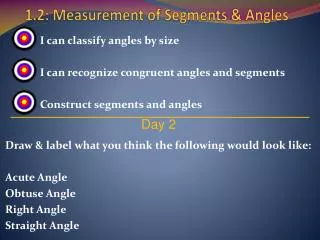
An acute angle is less than a quarter turn. For example, a one sixth turn is an acute angle. Click the mouse to see a one sixth turn acute angle. Click the mouse.
An obtuse angle is more than a quarter turn, but less than a half turn. For example, a one third turn is an obtuse angle. Click the mouse to see a one third turn obtuse angle. Click the mouse.
A reflex angle is more than a half turn. For example, a two thirds turn is a reflex angle. Click the mouse to see a two thirds turn reflex angle. Click the mouse.
Now watch Angles 2 – Measuring angles